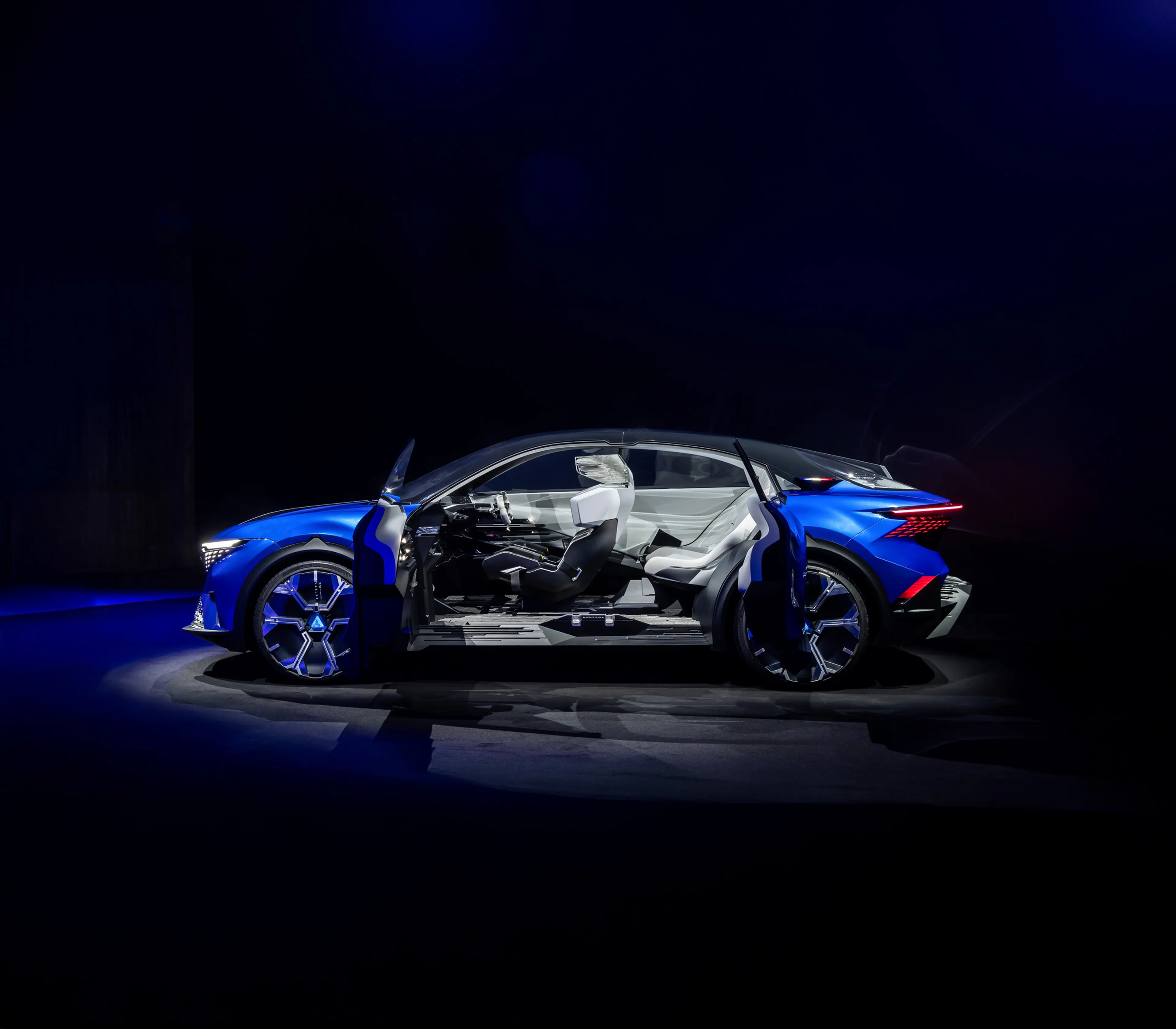
From ideas to the road: the role of pre-production vehicles
Published on
Article summary

Under the spotlights of a motor show, on a test track or hidden beneath camouflage, the vehicles we discover before production do not all tell the same story. Concept car, demo car, mule, show car: each plays a specific role at a particular stage, whether to explore, demonstrate, validate or reveal. Here is a behind-the-scenes look at the journey that turns an idea into a car.
Key takeaways
- The concept car explores: a vision, a use case, a design language or an innovation, without necessarily announcing a production model.
- The demo car demonstrates: it makes technologies tangible, measurable and testable.
- The mule tests: it validates the functions and components of a future vehicle under development conditions.
- The show car previews: close to the production version, it reveals the key features of a future model to the public.
- The Art Car creates: the result of an artistic collaboration, it gives rise to a one-off or highly limited creation.
It often all starts with a sketch, an intention or a question: what if the interior could simply adapt to each driver? What if technology could help reduce a vehicle’s carbon footprint? What if the next model introduced a new design language? At this stage, the production line is still a long way off. The idea first needs to take shape, be confronted with reality and then evolve.
Concept cars, show cars, demo cars: these vehicles may look alike, but each serves a distinct purpose. Some explore new possibilities without promising a production model. Others combine innovations to prove they work together, gather data on the road, or prepare the unveiling of a future vehicle. This variety reflects the combined efforts of the design, engineering, software, validation, manufacturing and brand teams.
First chapter: imagining with the concept car
The journey begins with the concept car. Its role is not necessarily to announce the next vehicle to enter production. Above all, it is designed to explore: a vision of mobility, a use case, an architecture, a design language or a forward-looking technology. It makes a hypothesis tangible and allows the brand to express its vision of the future.
A concept car can therefore surprise, challenge or spark debate. Its freedom is precisely its strength: it gives teams a platform to bring an idea to life before the constraints of a production vehicle begin to shape it. E-Space Concept and Renault 8 Gordini Concept illustrate this approach to design, brand image and technological exploration.

E-Space Concept: a 100% electric MPV designed as a bright, modular six-seater lounge. Inspired by the original 1984 Espace, it reinvents the spirit of the “voitures à vivre” (“cars for living”). Presented on 12 October 2026 at the Paris Motor Show.

Renault 8 Gordini Concept: a 270 hp two-seater electric coupé with a low, sporty silhouette. It reinterprets the 1964 R8 Gordini, its twin white stripes and rear-wheel-drive architecture, with a “café racer” spirit. Unveiled on 24 September 2026 at the Paris Motor Show.
Second chapter: demonstrating with the demo car
A promising idea then needs to prove itself. This is where the demo car comes in. More than a display vehicle, it brings together realistic technologies to verify that they work together and deliver an observable benefit. It turns a promise into a tangible experience, sometimes on the road or track, and sometimes in front of the media or other external audiences.
Filante Record places electric efficiency at the heart of a demonstration in real driving conditions. Emblème brings a decarbonisation approach to life. R-Space Lab, meanwhile, explores the onboard experience of tomorrow’s “voitures à vivre” through a modular, bright and technology-rich interior. Three different projects, but one shared principle: demonstrating what innovation can actually achieve.

Filante Record: an ultra-lightweight electric single-seater with a streamlined design, serving as a true laboratory for efficiency. Its goal is to maximise range by optimising aerodynamics, weight and technologies without increasing battery capacity. Unveiled on 30 January 2025.

Emblème: a family vehicle with a shooting-brake silhouette combining a battery-electric powertrain with a hydrogen fuel cell. Its goal is to reduce CO₂ emissions over the entire life cycle by 90% compared with the 2019 benchmark. Unveiled on 4 October 2024.

R-Space Lab: a demonstrator with a one-box architecture, featuring a bright, modular interior and a connected cockpit. Its goal is to explore new uses and technologies for tomorrow’s “voitures à vivre”, without previewing a production model. Unveiled on 10 March 2026 during the presentation of the futuREady plan.
Third chapter: testing with the mule
While some vehicles take centre stage, others work behind the scenes. Away from the spotlight but closer to series production, the mule is one of the tools used in vehicle development. Its role is to test and validate components, functions or an architecture before the final vehicle becomes available.
Its appearance can be misleading. It may use the bodywork of an existing model, feature temporary components or be driven under camouflage. What matters is often beneath the surface: powertrain, steering, braking, software, chassis systems or new functions. Every kilometre driven helps teams answer a crucial question: is the solution robust enough to move on to the next stage ?

A110 Future, a mule previewing the future Alpine A110.
Fourth chapter: revealing with the show car
As the project moves closer to production, the story changes. The show car is no longer simply exploring what might be possible: it gives the public a highly advanced preview of a future vehicle. Close to the final production model, it reveals its silhouette, key design directions or brand promise ahead of the commercial launch.
Scenic Vision and Bridger helped establish ideas that would later become reality. The show car creates a moment of connection between the project and its audience. It builds desire, helps audiences understand the future model and marks a major milestone in the way its story is told.

Scenic Vision: a family vehicle whose exterior design previews the future Scenic E-Tech electric. Its forward-looking interior and electric-hydrogen powertrain explore more sustainable mobility. Presented on 19 May 2022 at the ChangeNOW summit in Paris.

Bridger: an urban SUV measuring less than four metres long, with rugged styling and a spacious interior, previewing a production model designed in India. Presented on 10 March 2026 during the announcement of the futuREady strategic plan.
Another story: bringing art and the automobile together
Not every automotive creation follows this path towards series production. With an Art Car or collaboration, the vehicle becomes a meeting point between a brand and an artist, designer or another brand. Production remains one-off or highly limited, with the primary objective being artistic, cultural and image-related.
R17 electric restomod x Ora Ïto and Renault 5 Diamant with Pierre Gonalons show how the automobile can become a means of expression and dialogue with other creative worlds.

R17 electric restomod x Ora Ïto: an electric reinterpretation of the 1971 Renault 17 coupé, this one-off creation combines carbon bodywork, sculptural lines and a retro-futuristic interior. Unveiled on 4 September 2024 at MAISON5 in Paris.

Created to celebrate the 50th anniversary of the Renault 5, the Renault 5 Diamant reinterprets the popular 1972 icon as a true work of art. Created with designer Pierre Gonalons, it blends the original model’s historic lines with precious details and contemporary design.
One project, multiple proofs
From the initial idea to the road, these vehicles are neither competing nor interchangeable. They represent complementary stages: the concept car opens up a new direction, the demo car gives credibility to innovation, the mule builds up validation data, and the show car prepares the vehicle’s first encounter with the public. The Art Car follows a different path, that of artistic creation.
Behind each of these forms lies the same collective momentum: learning faster, testing choices against reality and moving the project forward. So the next time an unfamiliar vehicle appears on a show stand, in a video or beneath camouflage, the first question will no longer simply be “what will it look like?”, but rather “what role does it play in the story?”