A robot that walks, lifts heavy loads and adapts to its environment: Calvin has all the makings of a technological feat. But behind the machine lies, above all, a human story: the encounter between two teams, one at Renault Group, the other at the French scale-up Wandercraft. A look behind the scenes of an adventure that began with two words, at the end of a conference.
A retenir
With Calvin, Renault Group is among the very first automotive manufacturers in the world to introduce a new-generation robot on its production lines.
Developed through a strategic partnership with French scale-up Wandercraft, this robot was developed in record time and is built on a dual logic of industrial complementarity and technological sovereignty.
Its primary mission is to improve operators’ working conditions by taking on the most demanding tasks: handling heavy loads, manipulating sharp parts, repetitive motions.
Mobile and versatile, it also addresses flexibility and productivity challenges, which are essential for the long-term competitiveness of factories and job preservation.
Discover the project's genesis in video
Robot and humanoid: two words
It all started on October 1st, 2024, at a Cap Digital R&D conference. Around the table were start-ups, SMEs, large companies, universities, business schools, investors, local authorities... Laurent Duthoit, robotics and physical AI expert at Renault Group, hears Jean-Louis Constanza, Wandercraft co-founder, announce his intention to produce humanoid robots. Two words that immediately resonated.
As early as October 15th, Laurent Duthoit visits Wandercraft's Paris offices; a few weeks later, around twenty engineers from the scale-up discover the Douai factory. The breakthrough was mutual.
Renault Group and Wandercraft: 100% French collaboration
Everything could have opposed the two companies. What brought them together was a common language: technology, industry, clients. Together, they decide to pilot the robot ‘as a system’, exactly the way a car is developed: Renault Group defines functional needs and use cases such as the handling of tires for example; Wandercraft responds technically. The development method follows the same logic, step by step: it starts in Wandercraft's Paris laboratories, then moves to the Flins innovation center, where the Douai wheel workshop was recreated, before arriving at the factory. . Weekly adjustment meetings with very concrete actions: adjusting the camera height, shortening the robot's legs or refining the software.
Eight months after the first meeting, Renault Group announces a stake in Wandercraft, coupled with a partnership agreement. While other countries are seeing more and more alliances between new-generation robots and manufacturers, this choice of 100% French collaboration makes full sense.
The roadmap is ambitious: around ten robots in place by end of 2026, then 350 in French and Spanish factories by end of 2027.
« The new generation of robotics will make it possible to enrich the tasks entrusted to our factory operators, by removing the most painful ones, on a physical or cognitive level. It is progress that benefits our teams, our industrial activity and our customers.”
Half a century of robotics in automotive factories
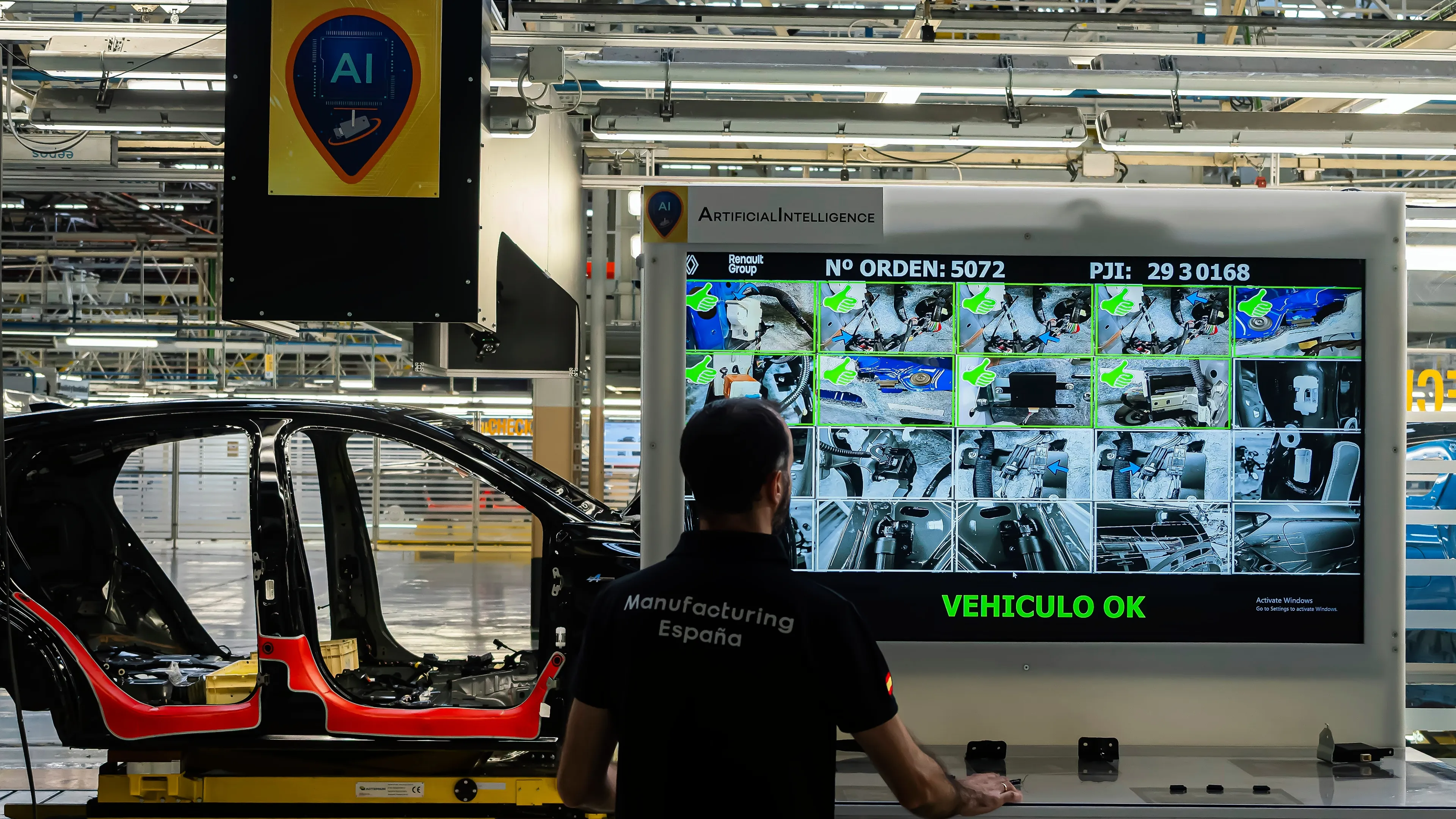
While Renault Group has been developing robotics expertise for more than fifty years, the 11,000 traditional robots in its factories have their limitations: each is dedicated to a single task. Calvin changes everything: thanks to physical AI, it perceives reality, adapts to it and can switch missions.
Currently being tested at Douai, Calvin grabs tires two at a time, roughly thirty kilos at once, exactly the type of demanding effort that wears on an operator. Where most robots on the market handle 3 to 10 kilos, Calvin carries 40 to 50.
To maintain balance, it relies on a swarm of sensors: inertial measurement units in each limb, force sensors under its feet, and an RGBD camera that lets it ‘see’ its environment. This ultra-fast perception, made possible by AI, would have been unthinkable just five years ago.
The robotics park of Renault Group
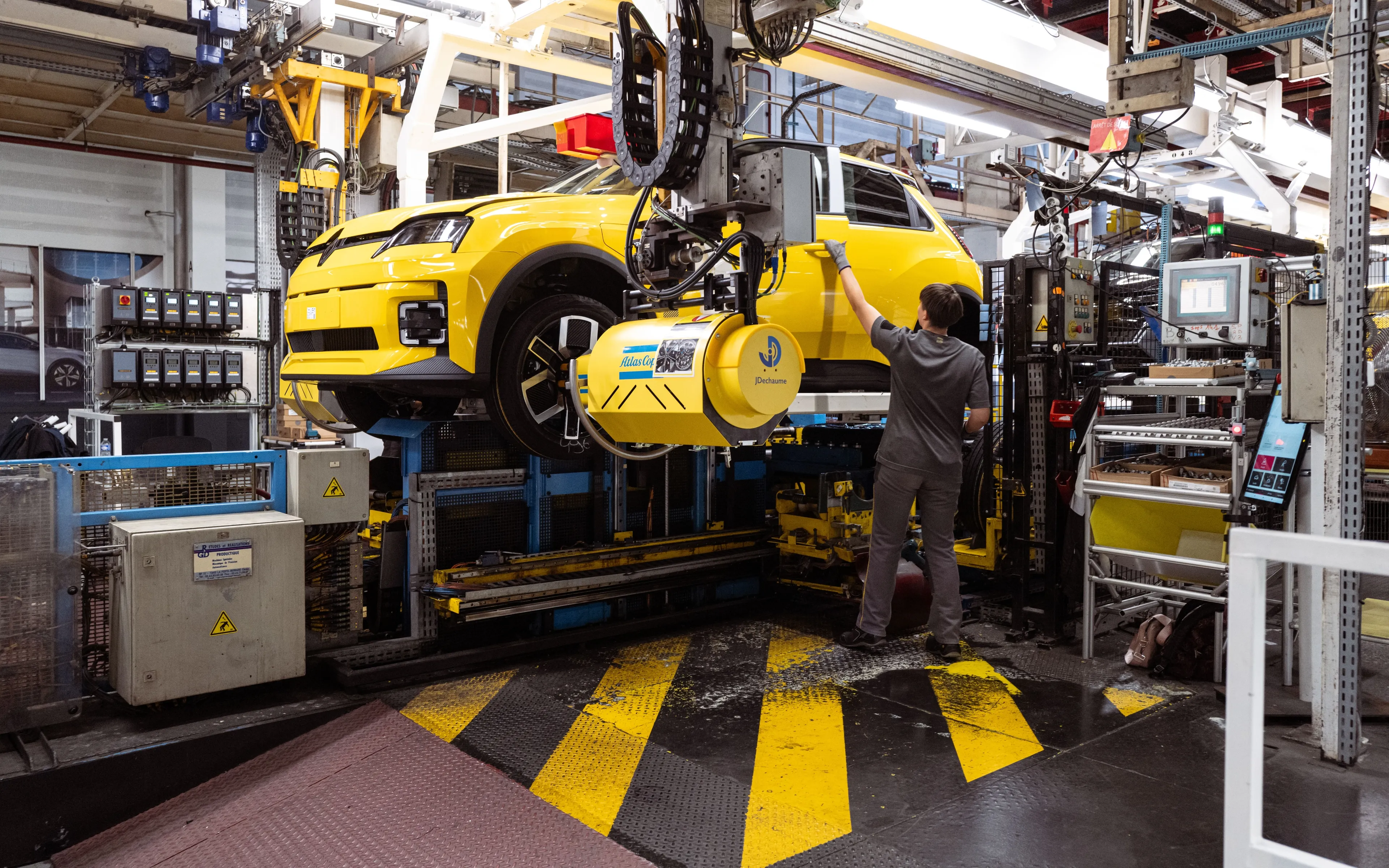
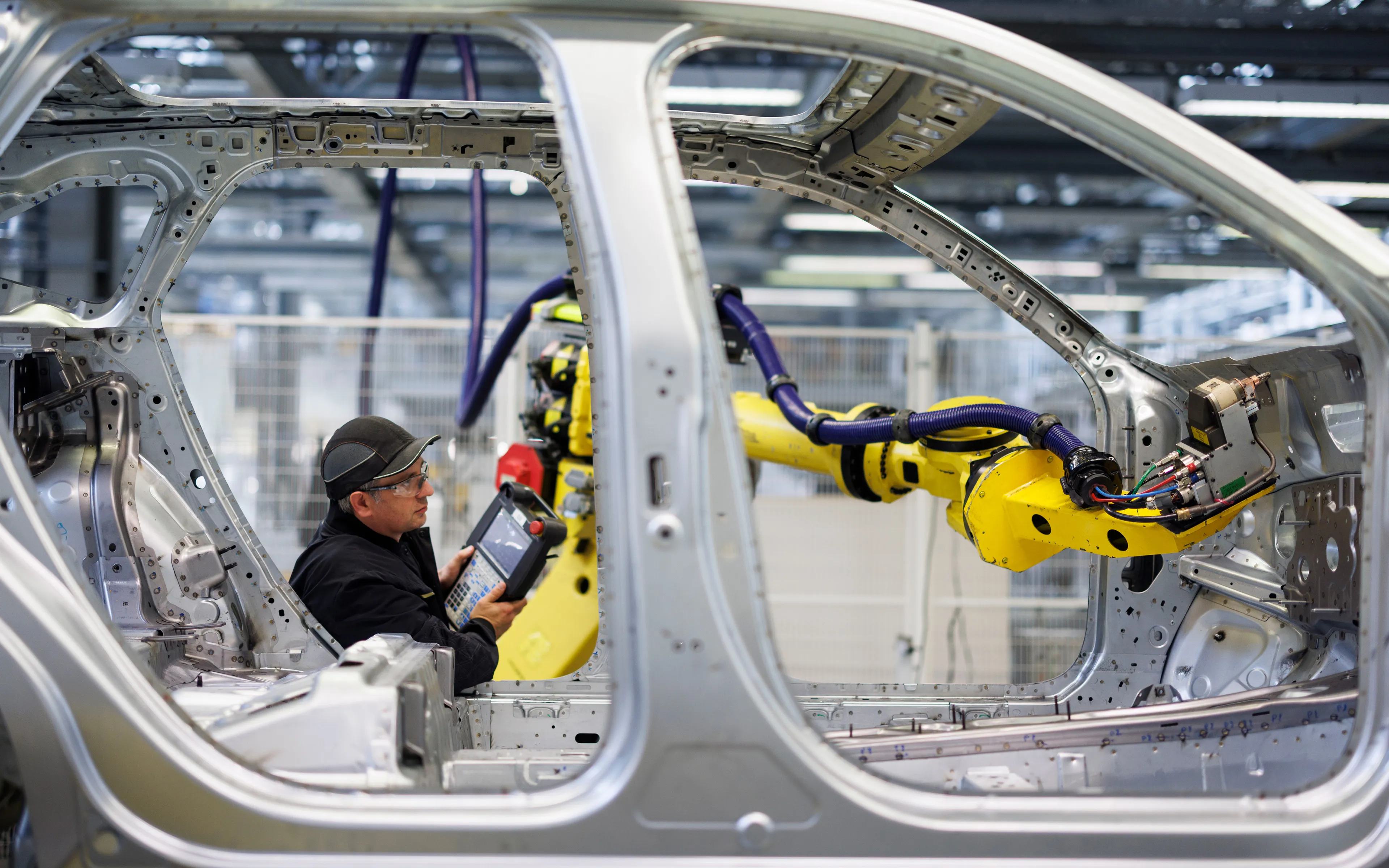
11,000 industrial robots ‘6 axes’ (welding, picking, parts transfers) in 23 factories.
5,000 AGVs (Automated Guided Vehicles) and 100 AMRs (Autonomous Mobile Robots) for handling.
Bras robotisé –Encollage de pare-brise – Usine de Sandouville (France)
Bras robotisé– Soudure – Usine de Novo Mesto (Slovénie)
Automated Guided Vehicles – Usine de Busan (Corée)
Automated Guided Vehicles – Usine de Douai (France)
Automated Guided Vehicles – Usine de Tanger (Maroc)
Automated Guided Vehicles – Usine de Batilly (France)
Tomorrow, finer tasks in sheet metal work and painting
Calvin takes on the most demanding tasks to redirect operators toward roles where human intelligence is irreplaceable.
Tomorrow, more dexterous hands will open the door to finer tasks in sheet metal work, painting and other sectors. Today, two challenges remain: robustness and integration into a high-speed production environment.
For Renault Group, Calvin’s development reflects a breakthrough innovation fully mastered: opening a new path, but in a gradual and perfectly controlled way. Even though the robot can already do far more than it could five years ago, its fine-tuning takes time. Because human dexterity and decision-making speed, rooted in experience and intuition, remain irreplaceable. Calvin is not a substitute for humans; it is their complement.
And when several Calvins roam the workshops, teams will remember that it all started with a meeting and two words spoken at the end of a conference.
Excelling in Industry 4.0 with AI and robotics, one of the objectives of the futuREady strategic plan
Calvin is a new-generation robot developed by Renault Group and the French scale-up Wandercraft. Mobile and versatile, it relies on physical AI to sense its environment and adapt to it. It can carry out a range of different tasks, something a conventional industrial robot cannot do. Its name pays tribute to Dr Susan Calvin, the ‘robot psychologist’ imagined by Isaac Asimov.