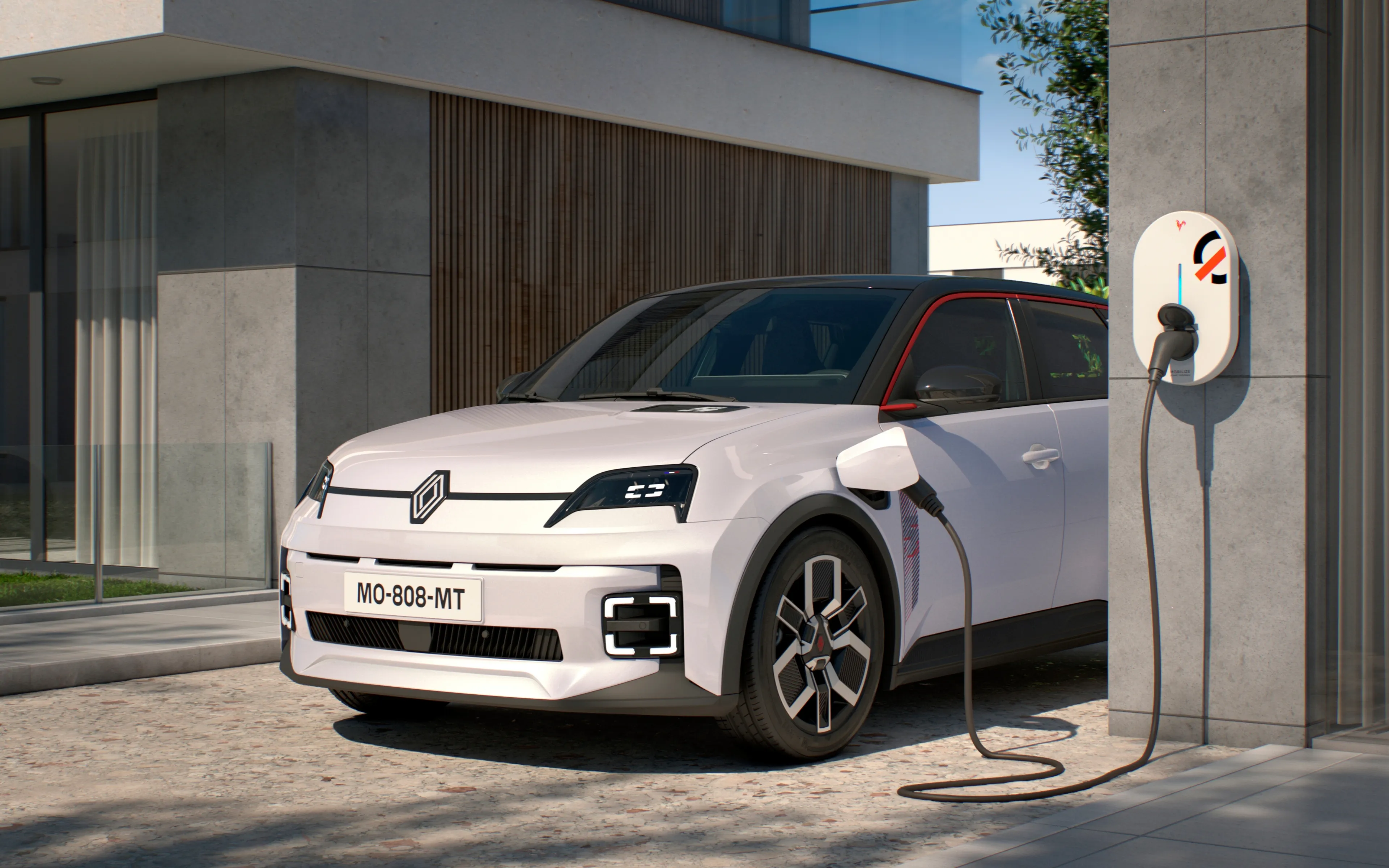
Power electronics: the invisible technology that makes electric cars work
Article summary
Drivers never see it, yet their electric car would go nowhere without it. Charging, accelerating, braking, recovering energy on the move: power electronics is at work behind almost every move the vehicle makes. Its mission? To squeeze the most out of every kilowatt-hour on board – for more range, lower consumption and sharper performance. Here’s how it works.
Key takeaways
Orchestrating the electric vehicle’s energy: power electronics converts, distributes and controls electricity between the charging point, the battery and the motor, every time the vehicle charges, accelerates and brakes.
Tangible benefits for drivers: by limiting energy losses, it helps improve the vehicle’s range and efficiency, particularly during charging and regenerative braking.
A strategic and sovereignty issue for Renault Group: drawing on more than fifteen years of expertise, the company aims to bring the main elements of power electronics in-house to deliver higher-performing vehicles.
What does power electronics do in an electric car?
From the charging point to the battery, from the battery to the motor, and all the way to the vehicle’s equipment, electricity flows in different forms and with different characteristics: direct or alternating current, voltage level, output. It has to be constantly converted and adapted to the electric vehicle’s various needs.
This is where power electronics comes in. It acts as the vehicle’s energy conductor: its job is to send electricity where it is needed, in the right form, at the right time and with as little loss as possible.
Turning electricity into motion
Contrary to what you might think, the electricity flowing through an electric vehicle is not uniform. Let’s take a closer look: electricity supplied by an alternating current (AC) charging point must first be converted into direct current (DC) by an on-board charger so that it can be stored in the vehicle’s traction battery. Between the battery and the motor, which runs on alternating current, an inverter handles the conversion. When braking, the process is reversed: the energy recovered by the electric motor is converted back by the inverter so that it can be stored in the battery.
Power electronics comes into play at each of these stages to convert, distribute and control energy flows. Every time you accelerate, every time regenerative braking kicks in, every time you charge, it is working constantly in the background.
So what does this mean for the driver? By optimising every electricity conversion, power electronics makes better use of the energy stored in the battery. It thus contributes to the vehicle’s range, charging efficiency and energy recovery.
Energy efficiency: a few percentage points that make all the difference
Efficiency is one of the key challenges in power electronics. Every time electricity is transformed – for example, when it passes from the battery to the motor and vice versa – some of the energy is lost, mainly as heat. Most of us have noticed that a phone charger can get warm while charging. In an electric vehicle, the power involved is thousands of times greater.
Improving efficiency by just a few points can therefore have a tangible impact on range and energy consumption. This is where materials chemistry and semiconductor technology come in – semiconductors being components that can let electric current through or block it in a controlled way. For example, using silicon carbide (SiC) semiconductors in an inverter can improve efficiency by almost two points, reducing the inverter’s energy losses. With the same battery capacity, this can add around 10 km of range on a vehicle such as Scenic E-Tech.
In other words, improving an electric car is not just about increasing its battery capacity. It is also about using the energy already on board as efficiently as possible.
Power electronics therefore helps make electric vehicles not only more efficient, but also more versatile. It is what now makes it possible to offer new features such as bidirectional charging: energy can not only flow into the battery but also back out to the charging point. A connected vehicle can thus feed electricity back into the grid when needed. This is the principle of Vehicle-to-Grid, or V2G.
Power electronics: a strategic challenge for the automotive industry
Beyond the technology itself, power electronics has become a major industrial issue. Converters and the software that controls them are now an essential building block of any electric vehicle.
For carmakers, the challenge is therefore no longer simply to fit basic electronic units into the vehicle. It is about mastering the technologies that determine their performance, from the choice of power semiconductors to the architecture of the converters and the software that controls them.
“At Renault Group, our expertise in power electronics has been built up gradually over more than fifteen years. It began with control and supervision electronics, notably battery management systems, then extended to the development of chargers and inverters, leading to our current ambition of bringing the main elements of power electronics in-house. Today, this expertise is a strategic technology area and a matter of sovereignty for Renault Group.”
Towards a new generation of electric vehicles
The story is far from over.
The next step is to integrate more functions into fewer electronic modules. The aim is to achieve greater efficiency, compactness and simplicity, while reducing system cost and complexity.
In the future, these architectures will also pave the way for new features, such as optimised fast charging, better battery management in cold weather and improved integration of the vehicle’s various electrical systems.
Power electronics is one of the technologies that will do the most to make electric vehicles more efficient, more affordable and higher performing. Because the future of electric mobility depends not only on how much energy we can store, but also on how well we use it.
Definitions
All the technologies used to convert, distribute and control electrical energy in the vehicle. In particular, it adapts electricity to the needs of the battery, the motor and the various pieces of equipment.
FAQ
01
What does power electronics do in an electric car?
02
How does power electronics affect range?
03
What role does the inverter play in an electric car?
04
Why use silicon carbide?
05
What role does power electronics play in bidirectional charging?
06
How does power electronics benefit the driver?
Power electronics converts, distributes and controls electricity within the vehicle. It constantly adapts electricity to the needs of the battery, the motor and the various pieces of equipment
Each time electricity is converted, some energy can be lost, mainly as heat. By limiting these losses, power electronics makes it possible to make better use of the energy stored in the battery, thereby contributing to the vehicle’s range.
The inverter converts the direct current supplied by the battery into alternating current that the electric motor can use. During regenerative braking, it also enables the recovered energy to be stored in the battery.
Silicon carbide, or SiC, is used in some power semiconductors to improve their efficiency. In an inverter, this technology reduces energy losses and improves efficiency, with a potential benefit for range.
Power electronics makes it possible to manage electricity flows in both directions. With bidirectional charging and Vehicle-to-Grid (V2G), the energy stored in the battery can be fed back into the power grid.
By optimising electricity conversions, power electronics makes better use of the energy available in the battery. It thus contributes to range, charging efficiency and energy recovery when decelerating and braking.