Automotive high technology and mass production: an impossible equation?
Published on
Article summary
Imagine having to design a rocket, load it with millions of lines of code, ultra-sensitive electronic systems and cutting-edge materials… then imagine having to produce one every 60 seconds, at an affordable price, with zero room for error. That’s the daily challenge of the automotive industry. At Renault Group, this equation (high technology and mass production) relies on a rare strength: dual expertise driven by teams skilled in both product design and industrial processes.
The modern car: a concentrate of hyper-technology
In 2026, a car is no longer just a mechanical assembly.
It is an embedded system of extreme complexity, where electronics, software, energy, advanced materials and artificial intelligence interact, featuring in particular:
- 70 to 200 sensors,
- up to 100 electronic control units (ECUs),
- nearly 200 million lines of code, more than a commercial airliner.
With the rise of electric vehicles, power electronics play a central role, the battery has become a strategic subsystem and high-strength steels now stand alongside increasingly lighter and higher-performance materials. Today, a car contains as much software as metal.
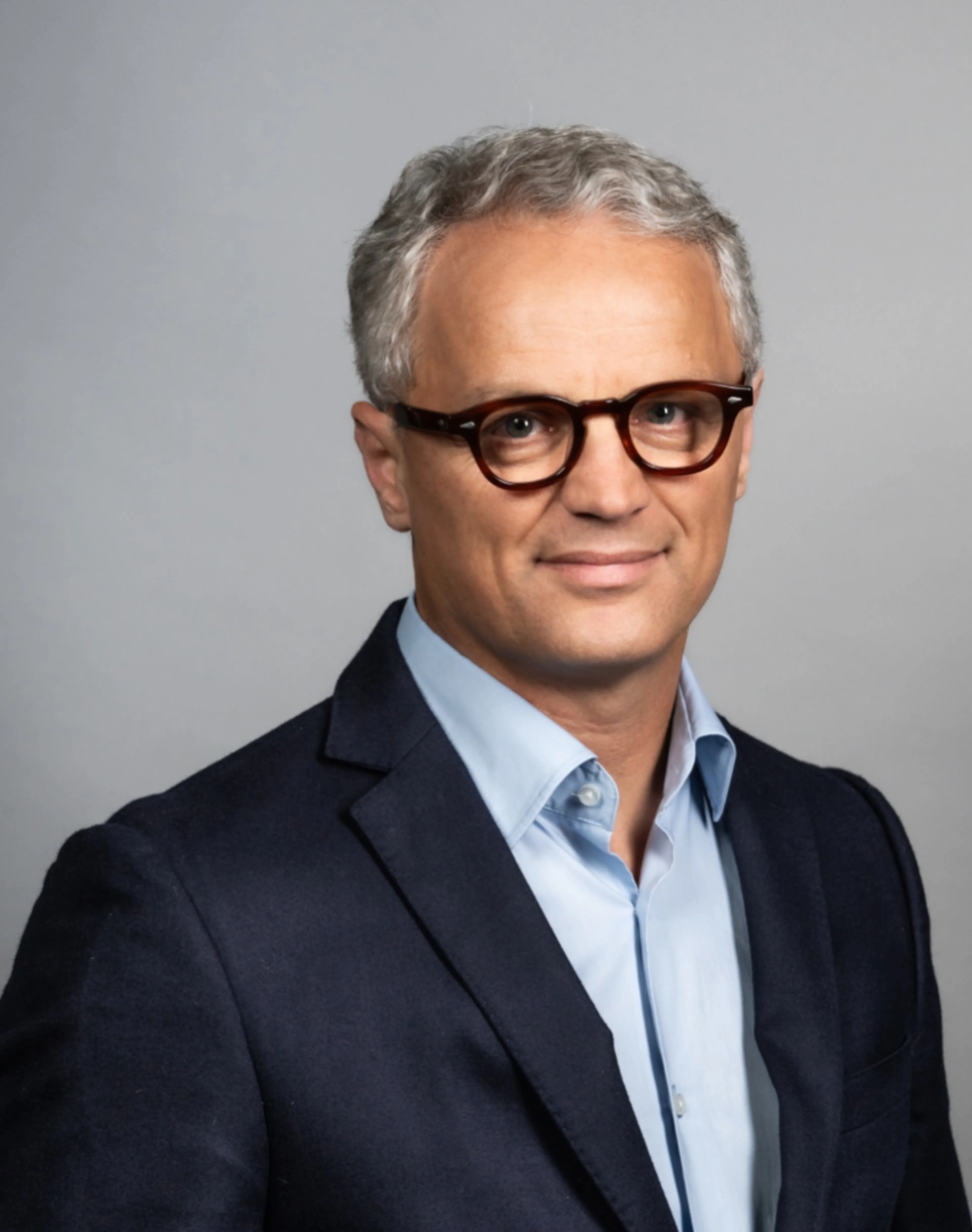
“The car is a highly technological object that draws on expertise in mechanics, energy, software, chemistry… and it must operate safely in sometimes unpredictable environments, with drivers whose training is not standardized. Bringing all these areas of expertise together in a mass-market product is extremely rare.”
Franck Naro
VP Engineering, Project Development & Serial Life
Aerospace and space industries integrate highly complex technologies, but in limited volumes. Home appliances or leather goods are produced on a very large scale, yet with lower technical complexity. The automotive industry combines both: a level of technology worthy of the most advanced industries and industrial production rates comparable to those of mass consumer goods.
It does so under a non-negotiable priority: absolute safety. A car cannot “crash” like a smartphone: it carries lives and must therefore operate with an extreme level of reliability.
Added to these technical requirements is a unique emotional dimension. A car is not purchased solely for its rational performance; it is also chosen for what it expresses, for the experience it promises and for the attachment it inspires. This blend of reason and desire makes the industrial equation even more demanding.


Product & process: an ongoing dialogue from the very first sketch
Designing such a complex object is an engineering feat. Producing it on a large scale, without compromising either on technology or on affordability, requires rare expertise. At Renault Group, this capability is built on a structuring convergence between product design and industrial processes. This dual know-how is the unique ability to develop innovative vehicles while mastering their large-scale industrial production.

“We are involved from the very first sketch. We bring in industrial requirements at a very early stage so that they are integrated from the vehicle’s initial design.”
Karine Humbert
VP Industrial Strategy and Corporate Operations
This means that the plant does not step in at the end of the project, once everything has been finalized. It takes part in the thinking from the outset: number of parts, technology choices, subsystem architecture and cost/performance trade-offs.
This co-design approach makes it possible to:
- avoid innovations that are difficult to industrialize,
- reduce costs,
- secure and streamline production launches,
- accelerate development cycles.
“Close alignment between product and process is essential. If you are too product-focused, you create unmanageable complexity in the plant. If you are too process-driven, you stifle innovation,” summarizes Franck Naro. “The balance is subtle.”
This pursuit of balance is a strong differentiator. At some manufacturers, engineering takes the lead and industrialization must adapt. At others, a process-driven logic can constrain creativity. At Renault Group, performance arises precisely from the constant dialogue between the two.
Industrializing before industrialization: the strength of prototypes
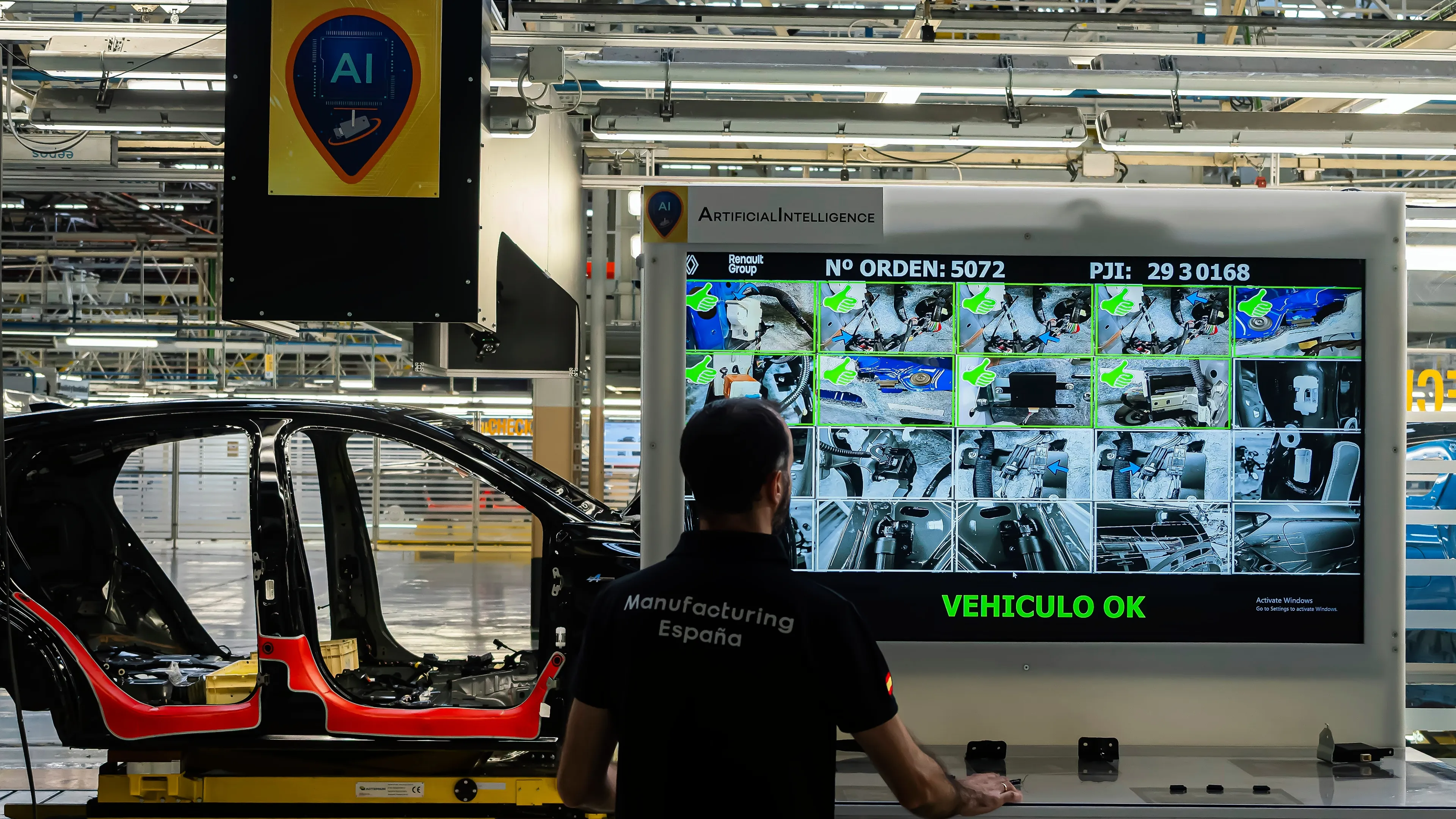
At the Guyancourt Prototype Manufacturing Center, vehicles are assembled under conditions close to mass production, using robots and operators, just like in a factory. The goal is not only to validate the vehicle’s design, but also to test the industrial system itself, identify critical points and optimize processes upstream.
This approach significantly reduces risks at industrial launch, shortens timelines and limits the investments required to introduce a new model into a plant. It explains why the “entry ticket” at Renault Group is more controlled than in other organizations.
What is the “entry ticket” in the automotive industry?
The “entry ticket” refers to the investment required to develop and launch a new vehicle model.
It is a very substantial amount, often in the range of several hundred million euros, because it includes:
- the complete design of the vehicle;
- the development of embedded technologies (electronics, software, driver-assistance systems, etc.);
- the creation of the industrial tooling required for production;
- obtaining all regulatory approvals, which are mandatory before any commercialization.
With the rise of electrification and the growing importance of embedded software, this amount has continued to increase. Manufacturers must now master battery technologies, advanced power electronics, driver-assistance systems, and have production infrastructures adapted to these new technologies.
When process becomes a lever for innovation: the JetPrint Paint example
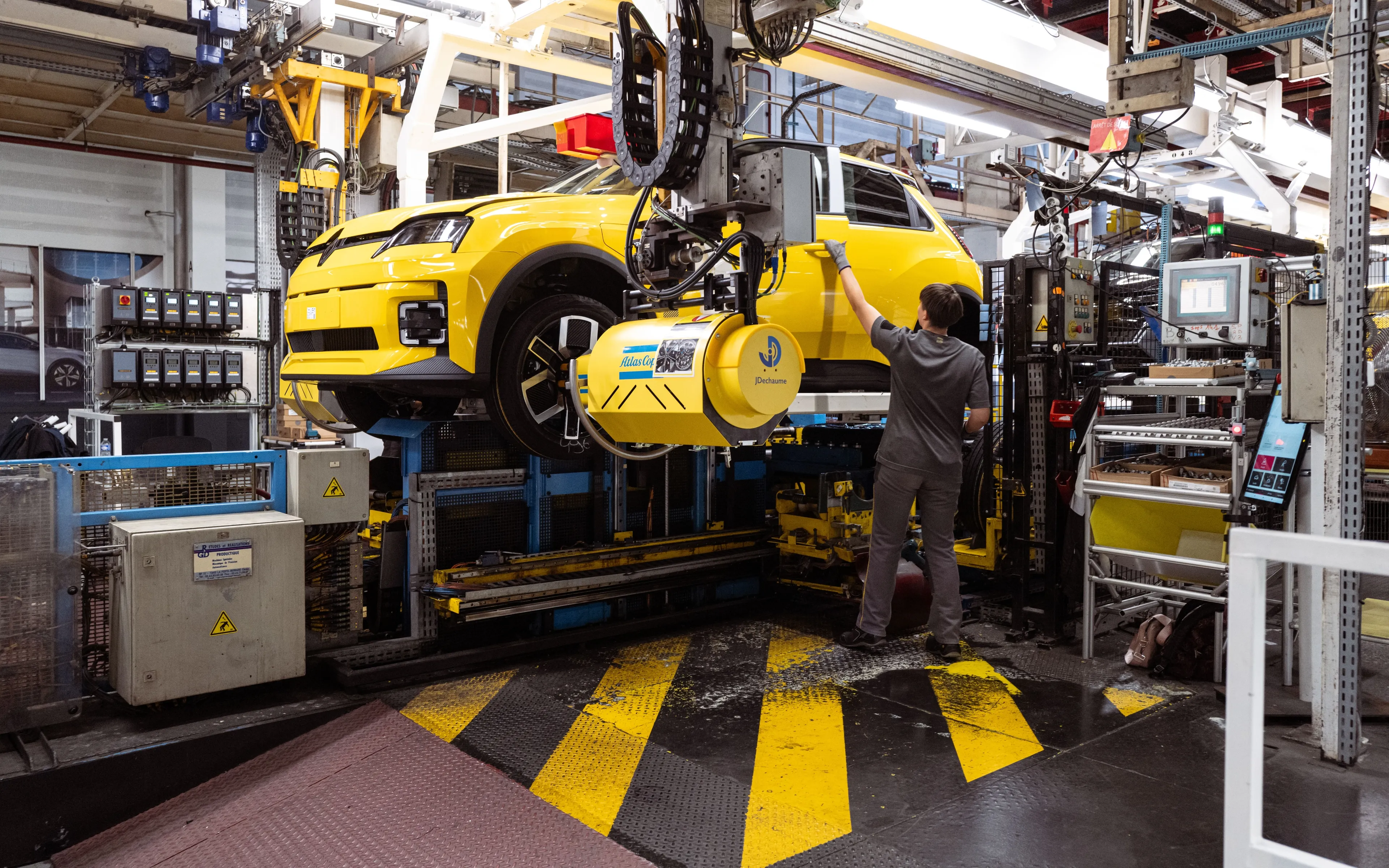
The arrival of the Renault 4 E-Tech electric in Maubeuge in 2025 perfectly illustrates the synergy between product development and the adaptation of industrial processes.
To meet the vehicle’s specifications and offer a premium two-tone customization option, the plant teams had to take on a double challenge: launching the site’s first 100% electric passenger vehicle while implementing a completely new painting technology.
This close collaboration between product design and process engineering led to the development of JetPrint Paint, a world first for a mainstream manufacturer. Where the traditional method required two paint shop passes, several hours of manual masking and double oven curing, the new process integrates the two-tone paint application directly into the production line. Two robots now paint the roof and hood in just six minutes, with flawless precision.
Benefits:
- 1.7 GWh of energy saved,
- 331 tonnes of CO₂ avoided,
- zero paint waste,
- zero masking consumables required.


Speed, competitive pressure and digital continuity: the Renault Group signature
Technological complexity is no longer the only challenge. Speed has become a strategic factor. In a context where some players, including Renault Group, notably with the new Twingo, are now capable of developing a vehicle in less than two years, the ability to accelerate without compromising quality or driving up costs is decisive. “We operate in an environment of fierce competition,” recalls Karine Humbert. “We must successfully deliver a technological, affordable product within very short timeframes, without any compromise on quality and safety.”
Added to this requirement is particularly strong economic pressure across the markets and segments where Renault Group operates. In an environment shaped by a less linear energy transition, intensifying international competition, particularly from Asia, and persistent macroeconomic volatility, every product and process decision must incorporate rigorous cost discipline while preserving value and margins.
This is where the Renault Group signature fully comes into its own.
Advanced digital continuity
The close connection between product and process is supported by advanced digital continuity. An engineering change is immediately reflected in the virtual industrial environment, making it possible to simulate impacts, anticipate constraints and optimize decisions even before actual production begins.
This organizational and digital integration, still not developed to this extent by some manufacturers, acts as a powerful accelerator in terms of time-to-market and risk control.
Electrification as a revealer of higher standards
After more than a hundred years of internal combustion engines, Renault Group has, in just a few years, carried out a major industrial transformation to design and produce electric motors. A significant challenge: although electric powertrains contain fewer parts, the technology itself is highly complex and requires extreme precision. This shift has demanded an even stronger integration between product design and industrial processes: dedicated platforms, integration of battery packs into the floor structure and entirely new assembly lines.
The Cléon site, for example, perfectly illustrates this capacity for adaptation and continuous improvement: its flexible production lines now manufacture three different motor variants and the site has integrated new activities related to power electronics in order to master the entire value chain.
“The product/process approach is our expertise,” concludes Karine Humbert. “It connects what we want to produce, a technological object, to the way we manufacture it so that it is as affordable as possible, with a high level of quality and within the shortest possible timeframes.”
Renault Group has mastered an equation that few players worldwide are able to solve: designing a high-tech object and producing it at scale, while ensuring safety, quality, affordability and speed. It is its dual DNA: those who dream up the car and those who manufacture it work together, continuously. It is this alliance that makes it possible to build, quite literally, a “rocket” every 60 seconds.
FAQ
01
Why is the automobile considered a high-tech object in 2026?
02
What does Renault Group’s dual product & process expertise mean?
03
How does Renault Group reduce the “entry ticket” of a new model?
04
How does electrification strengthen product/process synergy?
A modern vehicle integrates up to 200 million lines of code, 70 to 200 sensors and up to 100 control units. It combines mechanical engineering, power electronics, software and artificial intelligence, all under extremely demanding safety and reliability standards.
Dual product and process expertise refers to the close collaboration between engineering and industrial teams from the very first vehicle design stage. This co-development approach ensures cost, quality and timeline control while enabling large-scale production.
Through early industrialization of prototypes, highly flexible manufacturing plants and advanced digital continuity between engineering and production, Renault Group limits the investments required to launch a new vehicle.
The integration of battery systems, power electronics and embedded software requires even closer coordination between engineering and industrial teams. This approach enables the large-scale production of complex electric vehicles.