When a car becomes a digital object
Published on
Article summary

Did you know that a car contains more lines of code than a commercial aircraft? That it is one of the most recyclable everyday products? Do you know the economic weight of the automotive industry in Europe ? Ahead of the Paris Motor Show, we invite you to discover a series of surprising facts and figures that offer a fresh perspective on the automotive industry. Dive into the expertise behind a sector where some of today’s most significant transformations are taking shape, often far removed from clichés and conventional wisdom. Ready to be surprised?
A car is now a digital object as well as a physical one. Electronics, software and artificial intelligence are combined within it on a scale unmatched elsewhere in industry. A high-end model has close to 100 million lines of code, or fifteen times the number in a Boeing 787. At Renault Group, digital technology is used from the first design work through to the end of the vehicle’s life.
Key takeaways
- A high-end car has close to 100 million lines of code running on 70 to 100 control units. A Boeing 787’s avionics have 6.5 million[1].
- Cars must continually respond to the demands of their surroundings. Since 2022, European regulations have required driver-assistance systems that need sensors and software[4].
- Renault Group has invested in simulation for more than thirty years and halved its development times. It plans to develop its future vehicles in less than two years[3][7].
- At the Aubevoye Technical Centre, each prototype undergoes five years’ use in a few weeks, on 60 km of test tracks[7].
- The Software-Defined Vehicle replaces 80 control units with two supercomputers and allows remote updates. Its first application is the New Trafic Van E-Tech electric[8].
The traditional car was purely mechanical: between 1,000 and 2,000 parts put together on a fast-moving assembly line. That has changed substantially over the past fifteen years or so. In 2009, the magazine of the IEEE (Institute of Electrical and Electronics Engineers) was already reporting close to 100 million lines of code in a high-end car, running on 70 to 100 electronic control units distributed throughout its body. The Boeing 787's avionics and onboard systems, by comparison, have just 6.5 million lines (1).
The figures still apply today, with software and artificial intelligence now used together in vehicles. Renault Group's expert in immersive simulation and virtual reality, Stéphane Régnier, describes what this entails: “Today, a car is a combination of several dozen computers. These are all exchanging information. We need to check if those systems will communicate together and provide the right customer experience.”[3]


Why does a car need more software than an aircraft?
The comparison with aviation may seem surprising. Why would a car be more complex than an airliner? Much of the answer lies in its surroundings. For an airliner, take-off and landing are the two critical phases. In between, it flies more or less alone, at an altitude where nothing crosses its path, with the autopilot taking over. Cars face a denser environment all the time. An aerial view of the Place de l'Étoile in Paris shows how complex an urban environment can be. Pedestrians, cyclists, scooters, traffic lights, road markings and other vehicles all create possible interactions. Each has to be detected and interpreted, with a corrective response in a fraction of a second where necessary. These demands require sensors and alerts, which in turn require control units and software.
With 25,300 people having died on European Union roads in 2017 and 135,000 suffering serious injuries each year, European Regulation 2019/2144, adopted in 2019, phased in a series of advanced driver-assistance systems for all new vehicles. Between 2022 and 2026, automatic emergency braking, lane keeping, intelligent speed assistance, driver drowsiness and inattention warnings, and pedestrian and cyclist detection were thus made mandatory[4]. Meeting these regulatory requirements meant incorporating technology into vehicles: cameras capable of reading road signs, radar, sensors and the software that allows them to communicate. The benefit to the driver is tangible: a car can now, for example, brake automatically in an emergency.

Digital simulation, Renault Group’s Technocentre, Guyancourt, France

Renault Optimization Autonomous Driving Simulator (ROADS), Renault Group Technocentre, Guyancourt, France

Simulateur ROADS, Technocentre Renault Group, Guyancourt, France
Digitalisation in vehicle design: digital twins and simulators
Design departments also use digital tools, aiming to work faster and at lower cost. Experience gained from more than thirty years of investment in simulators has helped Renault Group halve development times[3]. The Group creates a digital twin of the vehicle that all the engineers and designers on the project can work with. They can test the vehicle in virtual environments before a single physical prototype is built[3]. William Becamel, lead expert in modelling and numerical simulation, describes the advantage: “You can run a lot of simulation, and you can change your technical definition very easily [in a digital environment]”[3]. The project is around 90% settled by concept freeze, when the chosen model is confirmed and its main characteristics are fixed. This milestone is reached before any physical prototype has been made[3].
ROADS, the Renault Optimization Autonomous Driving Simulator, lets that virtual work become an immersive driving experience. The platform reproduces vehicle behaviour and the sensations inside the cabin with a very high degree of accuracy. The 90-tonne simulator reproduces up to 1 G of acceleration on each axis. Under the 7-metre dome is a complete cabin with a steering wheel, pedals and screens[3]. Renault Group describes ROADS as the world's largest driving simulator. It is installed at the Technocentre, the Group's research and innovation centre, and is used from the first stages of design[5]. Tyres provide a concrete example: one or two sessions with an expert test driver can take the place of several months of prototyping with the tyre manufacturer and be enough to validate the model[3].
The purpose of the simulators and digital twin is to shorten development further. Under the futuREady strategic plan, Renault Group intends to develop every future vehicle in less than two years. Renault Group's teams are to carry out this work in France, at the Technocentre, with European suppliers[6]. The new standard relies on AI and the digital twin, with a target of 30% fewer parts needed for manufacturing by 2030[6].
The software-defined vehicle
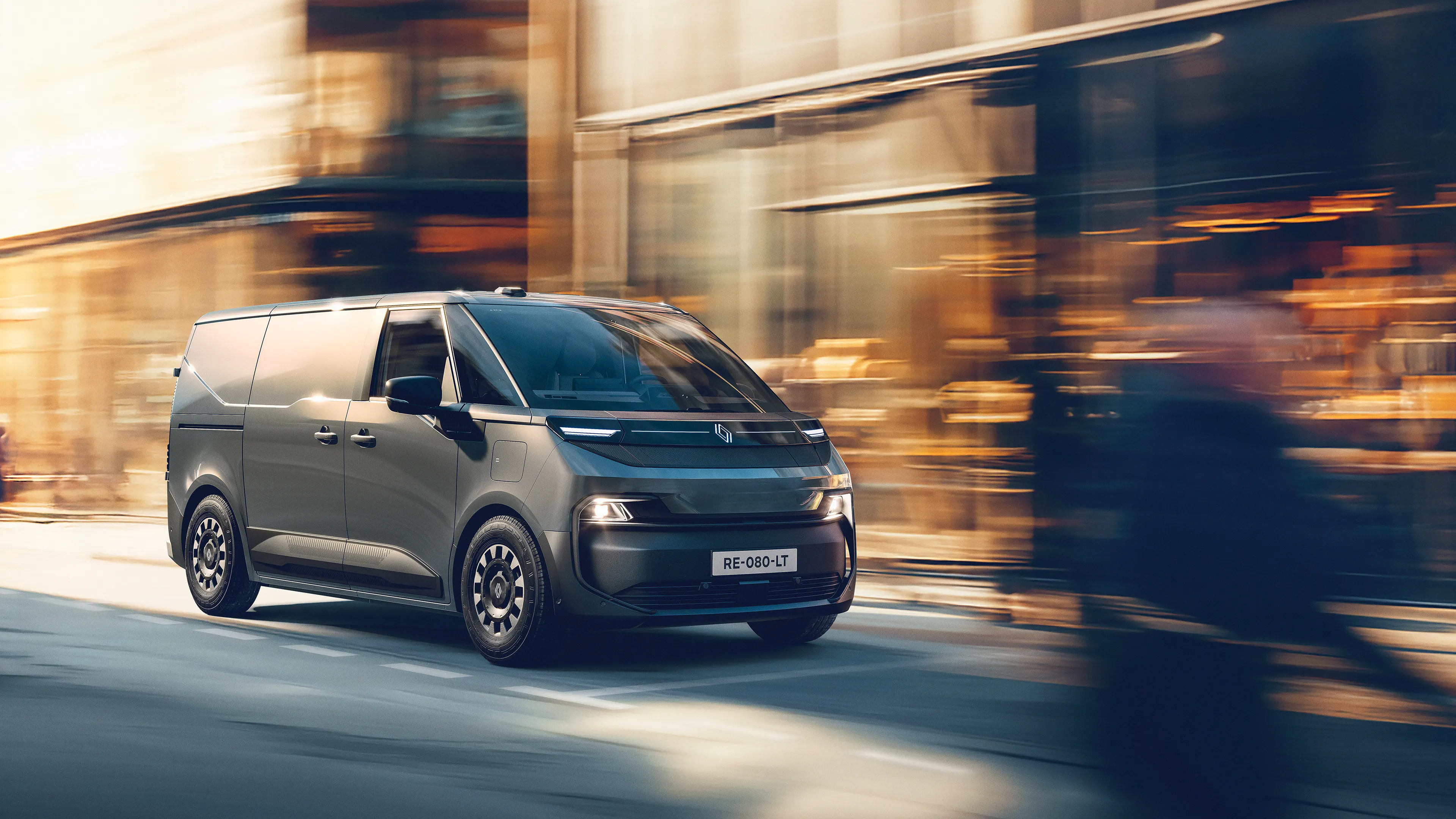
Digitalisation extends to the vehicle's architecture through the Software-Defined Vehicle, or SDV. Here, changing the software changes what the car can do; changes to hardware are no longer the only means of adding or improving functions. As with a smartphone, the vehicle can be updated, improved and personalised continuously, but the level of safety and cybersecurity is much higher[8]. Renault Group is replacing 80 control units and kilometres of connecting wires with two supercomputers. One is responsible for critical functions: driver assistance, chassis and engine. The other manages the cockpit and the experience inside the vehicle. Both are controlled by CAR OS, a dedicated Android-based operating system developed with Google[8]. Renault Group is also working with Qualcomm Technologies on a centralised electronic architecture for the next generation of vehicles[2]. SDV updates arrive remotely, without a workshop visit. Already, in this first generation, they cover up to 90% of the vehicle's functions.
Drivers receive regular updates and new functions for the life of the vehicle. Driving can be personalised, predictive maintenance improves safety, and continued improvements to the vehicle increase its residual value[8]. The first application is the New Trafic Van E-Tech electric, unveiled at the Hanover show in September 2026. Renault describes it as the first Renault Group vehicle, and the first light commercial vehicle in Europe, to use this centralised software architecture[8]. It is designed and built in Sandouville, France, and was voted Van of the Year 2027[8].
The next step in the development of this architecture is an AI-defined vehicle, planned for 2028 to 2030. AI will coordinate the vehicle's main functional domains, extending its role beyond individual functions such as the voice assistant. Remote updates will cover 100% of vehicle functions. The initial predictive maintenance services for tyres and brakes will expand as AI capabilities grow, while onboard services will adapt to the way each driver uses the vehicle.

Test Drives at Aubevoye technical centre, France

Winter test drives in Kiruna, Sweden
People remain central
“At the end, we sell a real product, a real car that is on the road and you need to feel it, you can't really replace the human in there,” says Guillaume Mercier, an expert in driver-assistance systems[3]. Digital tools therefore do not replace road testing. Erwan Casalis, an expert in customer performance for ADAS and autonomous driving, adds: “There's a lot of subjective judgment that can't be completely perceived in all the simulation tools that we see: we always need to drive the cars on open roads.”[3]
That work takes place at the Aubevoye Technical Centre in Normandy. The site covers 613 hectares, with 60 kilometres of tracks. In just a few weeks, each prototype undergoes the equivalent of five years' use. Testing adds up to 6 million kilometres a year[7]. Climate chambers vary the temperature from -30 to +55 °C, while driver-assistance systems are tested against more than 10,000 near-miss scenarios annually[7]. Renault Group's durability target is a vehicle that remains reliable and visually flawless after five years and more than 60,000 kilometres, using a method applied to over 200 critical parts[7]. Cars developped this way ar safer and able to evolve over time, with physical tests and simulations forming a feedback loop and road data continuously refining the digital models[3]. But human input remains central, because it is designed by people, for people.
FAQ
Between 1,000 and 2,000, depending on the vehicle’s size. Renault Group wants to cut the number of parts needed to build its vehicles by 30% by 2030, with help from AI and the digital twin [6].
Sources
[1] Robert N. Charette, ‘This Car Runs on Code’, IEEE Spectrum, 1 February 2009 (estimate by Professor Manfred Broy, Technical University of Munich; Frost & Sullivan projection cited in the article).
[2] Renault Group, Universal Registration Document 2025, p. 60 (French edition).
[3] Renault Group, renaultgroup.com magazine, ‘How Renault Group's vehicle development merges real life with virtual reality’, 19 January 2026 (experts William Becamel, Stéphane Régnier, Guillaume Mercier and Erwan Casalis).
[4] Regulation (EU) 2019/2144 of the European Parliament and of the Council, 27 November 2019, recitals and Annex II, EUR-Lex; applicable from 6 July 2022, with implementation stages in 2024 and 2026.
[5] Renault Group, Universal Registration Document 2025, p. 66 (French edition).
[6] Renault Group, ‘Renault Group en France’ (Renault Group in France) brochure, July 2026, p. 41.
[7] Renault Group, renaultgroup.com magazine, ‘Aubevoye Technical Center: durability at the heart of customer satisfaction’, 24 July 2025, updated 17 December 2025.
[8] Renault, press release ‘2026 IAA Transportation show in Hanover: Renault opens a new chapter in its LCV offensive with New Trafic Van E-Tech electric’, 14 September 2026; Renault, ‘New Renault Trafic Van E-Tech electric Van of the Year 2027’, September 2026.


