From combustion to electric: more than a simple evolution, a quantum leap.
Article summary
New gestures behind the wheel, infrastructure to rethink, engineering that must reinvent itself and a planet to take care of. The shift to electric disrupts far more than a technology. A transition that is at once personal, systemic and ecological, which Renault Group approaches as a global challenge. A conversation with Vittorio d’Arienzo, VP Group Product.
Is the true revolution of the electric vehicle not that of the driver?
V. d’A.Yes, absolutely! Whether combustion or electric, drivers’ expectations remain the same: reliability, safety, controlled running costs and that little thrill in the face of a car that influences you. A beautiful body, a design that makes your heart skip a beat.
What changes, on the other hand, is everything else. And the shift is deeper than it appears. In Europe, a car is on average more than ten years old. Its driver keeps it for between eight and twelve years, before finding themselves, overnight, face to face with a radically different vehicle. Not just electric. Different in its gestures, its reference points, its reflexes: a true quantum leap in the way it is used!
From manual to automatic gearbox: “I no longer use the clutch, I no longer change gears. Gestures I had made thousands of times.”
From simple Bluetooth to extended connectivity: “Where I simply plugged in my phone, I now find myself facing a digital ecosystem I haven’t yet mastered.”
From filling up with fuel to charging: “Where I used to stop for five minutes at the station, I now have to plan and anticipate.”
Fuel or range: “Where I used to glance at my fuel gauge, I now have to interpret a battery percentage whose real limits I don’t yet know.”
Alpine A390 GTS – Automatic gearbox
Renault Megane E-Tech Electric phase II – Charging stations map
New Renault Twingo E-Tech Electric – Battery level display
This is perhaps where the automotive industry underestimated the challenge: not that of technology, but that of support. Providing guidance. Helping every driver to get to grips with this new world.
Because the advantages of electric are very real: smoother driving, an unprecedented level of connectivity, a renewed everyday experience. The key is to cross that threshold with confidence.
This is precisely the ambition that must guide Renault Group as the leader in ‘cars to live in’: simple, accessible, intuitive. A vision brought to life in a dedicated range, from ZOE to Megane, from Scenic to Alpine. And most recently, through two iconic models: the R5, with no compromises on design and driving pleasure, and the New Renault Twingo E-Tech Electric, which redefines the standards of its segment in terms of space, efficiency and price.
Renault ZOE - 2016
Have drivers taken the plunge?
V. d’A.Many bought the R5 ‘even though it is electric’. They were not necessarily convinced EV drivers, just people who fell in love with the car and took the leap. That may be the key takeaway: if you offer the right car and support the customer, they will come to electric. And once they have tried it, they don’t go back. As switching from a classic phone to a smartphone: you wonder how you ever managed before!
Today, Renault Group has made a quantum leap compared to the previous generation of electric vehicles. The transformation is therefore no longer solely a question of product.
Should we look beyond the car?
V. d’A. Without a doubt. The next step is to rethink, at a societal level, everything that must guide the customer in this new world: charging points, infrastructure, stability and cost of energy. The course is set for electric, and the current context is accelerating it: the cyclical rise in fuel prices is naturally pushing drivers to reconsider their habits. It is up to us to ensure they confirm that choice. Fuel prices are not something we control but ease of charging, purchase cost, simplicity of use: that is our territory.
As a manufacturer, Renault Group plays its part: delivering the best products and services at the right price. Because car usage is part of a lifestyle, a value chain: the purchase price, the daily cost of electricity, the ease of charging at home or at the office or even finding an equipped parking space.
A mass transition to electric vehicles is within reach, provided we collectively build the ecosystem that will make it possible.
Charge at home
Plug Inn – Fast charging station
« Once you’ve experienced the silence, smoothness and simplicity of an electric vehicle, there’s no going back. »
Energy transition, societal transition… and ecological transition?
V. d’A.A clarification is needed, directly linked to what has just been said: to get an environmental impact, we must not only design and produce electric vehicles but above all sell them. Volume effect is not just a commercial indicator, it is an environmental lever in its own right.
But the commitment does not start with the sale. From the beginning, environmental considerations must be embedded as fundamentals, even more so as basics, from upstream to downstream. The backbone is sustainability.
A durable vehicle is, above all, an efficient one. Our philosophy rests on a simple principle: right-sizing. Using fewer resources to produce, less energy to drive, and ensuring that day to day, electric is less costly than combustion. Aerodynamics, braking, air conditioning, wheel size: every technical choice converges toward the same goal. Consuming less to get from A to B, the user’s primary need, while reducing environmental impact. Our new Renault Twingo E-Tech Electric is proof of this: long range, small battery, 1.2 tons. A benchmark in terms of space, efficiency and design. And a model we intend to replicate.
Twingo E-Tech Electric production at the Novo Mesto plant (Slovenia) – Quality control
Do you see significant differences between markets, particularly European, Chinese and Indian?
V. d’A.While low-carbon mobility is a global necessity, the way it is perceived varies from country to country.
In Europe, history speaks for itself and its cities bear the mark. Paris, London, Madrid, Rome: narrow streets, dense city centers, a culture of compact, agile cars that are easy to park. But small does not mean basic. This is perhaps one of the great distinctive features of the European market: it is the only one capable of offering a compact car with all the features of the segment above. Compromises on size, but that’s all! Connectivity, bold design, driving pleasure intact: the R5 is the perfect embodiment. Europe is also a mature and aging market, with an average buyer age of 56; a market attached to emotion and status. The challenge here is not technological: it is about proving that choosing electric does not mean giving up driving pleasure or the image of one’s car projects. An environmentally friendly car does not have to be boring, that is precisely Alpine’s ambition.
China is a completely different picture. Its cities were designed for the car: wide thoroughfares, ample parking, space. Cars are naturally larger and electric vehicles have already found their audience: adoption is no longer a question, it is a given. What characterizes the Chinese customer is constantly evolving expectations: always more connected, always more innovative. The battle now plays out on features and the ability to surprise.
Shanghai (China)
India occupies an intermediate position. As in Europe, small cars are popular, for reasons of affordability as much as urban practicality. And the key word here is affordable: price remains a determining factor. What sets this market apart is also its youth: the average buyer is ten to twenty years younger than in Europe. Less anchored in past habits, more open to change, they adopt new technologies more naturally. Expectations are evolving rapidly and electric is gaining ground, driven by a generation with no old reflexes to unlearn.
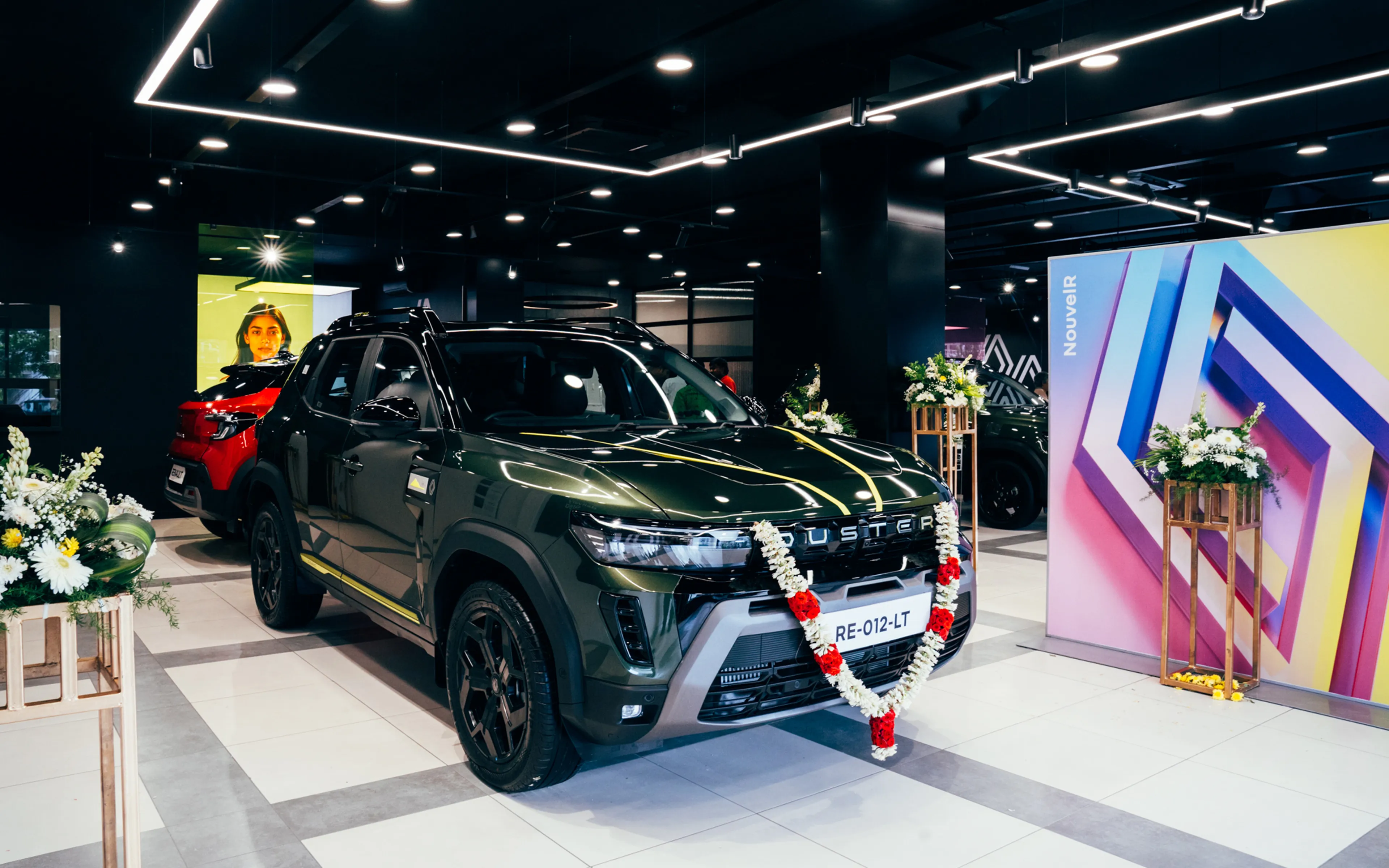
Mumbai (India)
What does ecological transition mean for a car?
V. d’A.The ecological transition applied to the automotive sector is one of the most complex industrial challenges. It requires considering the entire life cycle: the energy needed for production, use and end-of-life treatment. Each component, tyres, plastics, semiconductors, metals, mobilises specific materials, technologies and expertise.
What makes the car unique is precisely this combination of mass production and complexity. Millions of units, each incorporating dozens of materials and technologies to meet requirements of performance, acoustic comfort, safety…
This is where both the challenge and the opportunity lie. Because if the complexity is immense, the leverage effect is equally so: reducing by one gram of CO₂ the footprint of a component produced in several million units represents a considerable environmental impact. Every gain, however small, multiplies on an industrial scale.
Sustainable development: constraint or competitive lever?
V. d’A. The answer is clear: it is a driver. Because every challenge imposed on engineering forces us to look for solutions that did not exist. The ecological constraint is no exception: it forces us to rethink our certainties, to explore new avenues, and to question habits that have been in place for decades.
We are going through a period of technological explosion. Combustion, electric, plug-in hybrid, range extender, new generations of batteries, never has the range of solutions been so wide… nor so uncertain. Everything will eventually converge. But it is perhaps from this somewhat chaotic period of ferment that the most unexpected ideas will emerge. The Twingo, with its small battery and long range, is a good example.
This effervescence also opens the door to forms of differentiation we would not have imagined a few years ago. Using recycled fishing nets for interior trim, for instance, is not a gimmick: it is a concrete response to a real question, one that also creates a new aesthetic and a new way of telling a vehicle’s story.
At its core, the ecological transition works like any strong constraint: it disrupts, it unsettles, it attracts new players. Electric will drive change in the automotive product. And it already has: once the silence, the smoothness and the simplicity of an electric vehicle have been experienced, no user goes back.