The electric battery, at the heart of our electrification strategy
Published on
Article summary

With a direct impact on the range and cost of the vehicle, but also on its performance and daily use, the electric battery plays a decisive role in the transition to the electric vehicle. Let’s dive into the Group’s battery strategy.
Key Takeaways
- Renault Group’s priority is to choose the battery best suited to customer needs, seeking the best balance between performance, cost and robustness.
- The Group relies on two battery chemistries for its electric range (LFP and NMC), each addressing different customer uses while preparing new generations of chemistries, including cobalt-free technologies and lithium metal exploration.
- The other key lever for Renault Group is based on an efficient integration of energy: the Cell-to-Pack solution allows more energy to be loaded into the same volume, and in the longer term the Cell-to-Chassis technology will complete this logic.
The battery of an electric car is an energy storage system, it powers the electric motor and allows the vehicle to drive. It consists of cells that store energy in chemical form and return it to the vehicle in electric form when needed. Thus, a battery’s overall performance is partly determined at the cell level: capacity to store energy, charge and discharge speed, aging or thermal behavior. But not only at this level!
Indeed, the Group’s roadmap on electric batteries is thus structured around two complementary levers:
- on the one hand improve battery cell performance by reducing costs (cell chemistry),
- and on the other hand better integrate these cells in the vehicle to store more energy in the same space (Cell-to-Pack integration).
Optimizing the chemistry of electric batteries to improve performance and competitiveness
When it comes to batteries, the conviction of Renault Group is that there is not, at this stage, a miracle technology, a unique chemistry capable alone to meet all the criteria of energy efficiency of electric cars. The challenge is rather to evolve technologies to find the best balance between performance, cost and robustness, according to the needs of each motorist, and ultimately, to offer the right battery for the right vehicle and the right use. In this equation, the choice of battery chemistry impacts the cost of the vehicle. Battery accounts forapproximately 30% to 50% of the total cost of an electric vehicle, and about 70% of the battery cost is related to battery chemistry.
Today, two battery chemistries are deployed on the Group’s electric vehicles: LFP chemistry (Lithium Iron Phosphate) and NMC chemistry (Nickel Manganese Cobalt). Less energy-dense, but cheaper and more robust, LFP chemistry makes it possible to offer a solution suited to vehicles for which the right level of range at the best cost is decisive, especially for urban and suburban travel.
But Renault Group is already preparing what comes next. A new generation of cobalt-free and silicon-based batteries is being explored for the medium term, with the ambition to achieve an energy density comparable to that of NMC chemistry while aiming for the cost and robustness of the LFP solution.
In the longer term, the Group is exploring the potential of lithium metal to reach a new milestone in terms of energy density. The goal is to achieve up to twice the density offered by NMC chemistry, with a cost and robustness comparable to those of LFP.
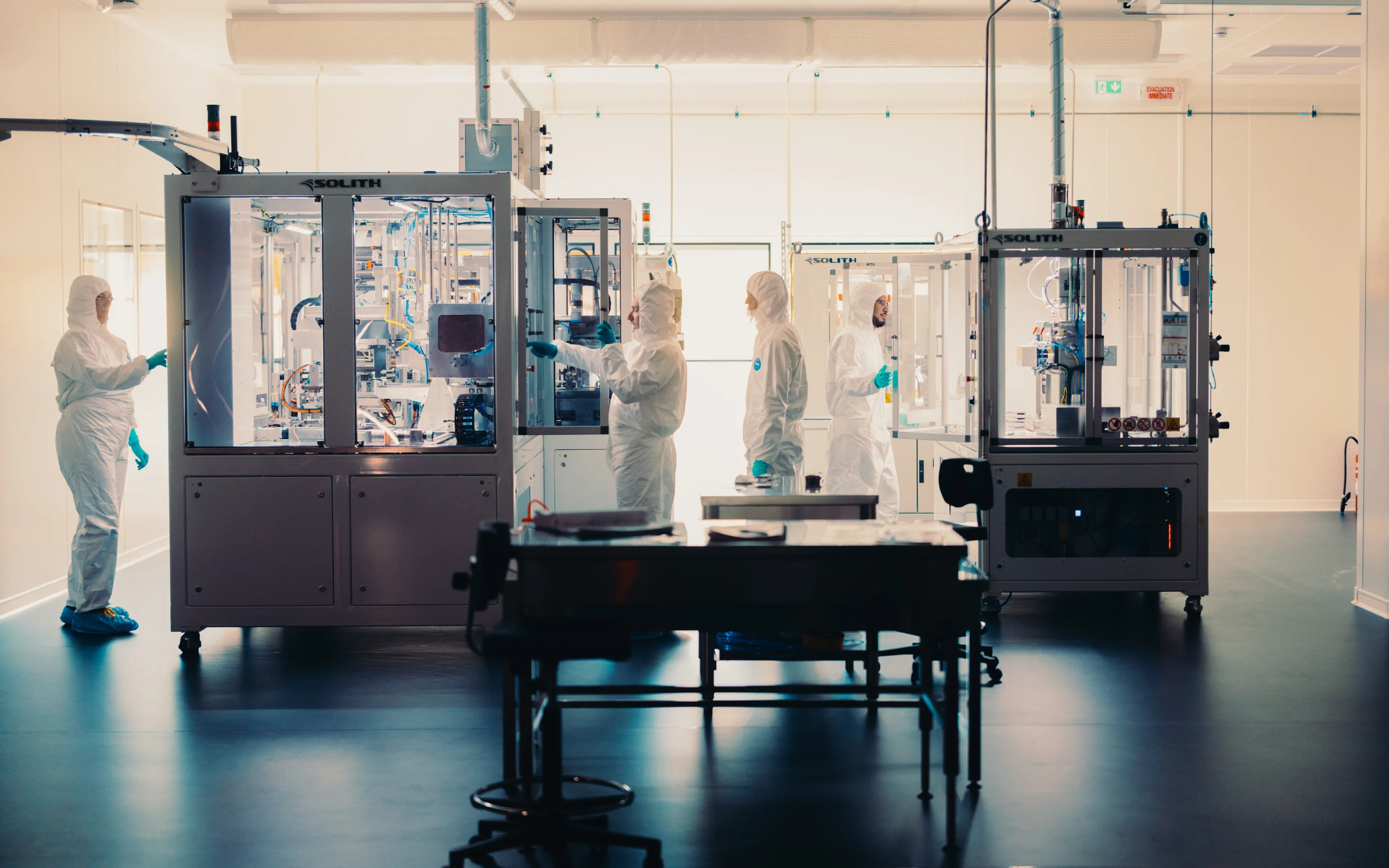
This research is already taking concrete shape at the Lardy Technical Center. Renault Group teams prototype new cells, test innovative chemistries and assess their performance and behavior within the Battery Cell Innovation Laboratory. It is thus possible to identify very early on the most promising technologies and the partners with whom they can be developed. In Ruitz, this approach will be completed at the beginning of 2027 by a Battery Safety Test Center. It will allow safety tests to be carried out internally on battery cells, modules and packs, subjecting them to extreme conditions to analyze their behavior and strengthen control over the safety of the battery.


Key Concepts of Automotive Battery Chemistry
- Cell: elementary brick of the battery, it is the smallest electrochemical element that stores energy. It can take several forms (cylinder, prism, pouch or flexible pocket, for example) and relies on different materials and electrochemical reactions to store and release energy.
- NMC Chemistry: built on a Nickel-Manganese-Cobalt assembly, these batteries offer high energy density, allowing them to store a lot of energy in a compact space. This chemistry is particularly interesting when autonomy is a priority. On the other hand, it uses nickel and cobalt, which weighs on supply costs.
- LFP Chemistry: Lithium-Iron-Phosphate based batteries offer a good compromise between relatively low energy density and cost, while providing robustness. This chemistry is very suitable for urban and suburban travel, and advantageous for making electric vehicles more affordable.
- Module: A grouping of several cells. Several modules are assembled and form the battery pack in the car.
- Battery pack or battery: the set formed by the cell modules and the different systems that allow to manage the operation of the battery, particularly its cooling system.
Energy integration, another battery’s energy performance lever
For Renault Group, advancing the chemistry of electric batteries is essential, but the performance of a battery does not depend solely on the cell. There is another part of the equation: optimizing how cells are assembled and integrated into the vehicle, in order to embed more energy in one space, while reducing mass, complexity, and costs.
It is in this logic that the teams of Renault Group have developed with LG Energy Solution the Cell-to-Pack technology. In a conventional architecture, the cells are first grouped into modules, themselves assembled in the pack (that is to say the battery). With the Cell-to-Pack, the module’s intermediate stage is removed to integrate the cells directly into the battery housing. It is thus possible to place more cells, and therefore more energy, in the same volume.
This optimization is particularly interesting with LFP chemistry. Its energy density being lower than that of the NMC, better use of the available space within the battery makes it possible to partly compensate for this difference, while benefiting from its economic advantage. The combination of LFP and Cell-to-Pack has helped reduce battery cost by about 20% since early 2026.
Twingo: LFP world premiere with the "Cell-to-Pack"
Available since 2026, Renault Twingo E-Tech electric is the first vehicle that uses an LFP chemistry battery with direct integration of the pouch-type cells into the battery (« Cell-to-pack »), developed in partnership with LG Energy Solution. This world premiere will be followed by other applications of this kind in the Megane, Scenic and then Trafic models in particular.


And the next step is already being prepared. With the Cell-to-Chassis, Renault Group is exploring an even deeper integration of the battery in the vehicle. The battery is no longer just an embedded element: it directly contributes to the structure and rigidity of the vehicle.
The goal is to achieve new gains in volume efficiency, weight, cabin space, and cost by designing the battery and vehicle architecture as a single, integrated system from the outset. This is an important development: the earlier the battery is integrated into the vehicle, the more the use of every kilogram and every liter available can be optimized.
The two levers activated by the Group in its strategy on electric batteries are therefore complementary: improving battery cells through new chemistries, while optimizing the way they are integrated into the vehicle to embed energy ever more efficiently.
FAQ
01
What are the main electric battery technologies used by Renault Group?
02
What is the difference between an LFP battery and an NMC battery?
03
What is the Cell-to-Pack technology and what are its advantages?
04
How does Renault Group improve the performance of electric car batteries?
05
What will the next generations of electric batteries be like? (option)
Renault Group mainly uses two battery chemistries: NMC (Nickel-Manganese-Cobalt), which offers a high energy density, and LFP (Lithium-Iron-Phosphate), less dense but more economical and robust. The Group chooses the technology best suited to each vehicle, its use and the desired range.
LFP and NMC batteries are built on different electrochemical materials, which has an impact on their energy storage capacity, called energy density. An NMC battery offers higher energy density, which allows more energy to be stored in a compact space and promotes range. An LFP battery offers less energy density, but it is more robust and less expensive, making it particularly suitable for urban and suburban uses.
The Cell-to-Pack consists of integrating the cells directly into the battery pack, without going through intermediate modules. This architecture makes it possible to use the available space more efficiently, to embed more energy in the same volume and to reduce certain parts, mass and potentially assembly costs.
Renault Group improves the performance of its batteries by acting on two complementary levers: cell chemistry, to optimize their energy density, cost and robustness, and their integration into the vehicle, notably through Cell-To-Pack, to carry more energy in the same volume.
Renault Group is working on a new generation of batteries without cobalt associated with silicon, targeting the energy density of NMC with the cost and robustness of LFP. In the longer term, the Group is exploring lithium metal, with the aim of doubling the energy density of NMC.