Quality at Renault Group: immersion into a silent yet spectacular transformation
Published on
Updated on
Article summary
In an automotive sector undergoing rapid change, quality must represent a true commitment to customers. Renault Group has made it one of its key drivers of transformation and has rolled out a fast-paced methodological and cultural revolution: factory digitalization, quality runs, industrial metaverse, real-time responsiveness… As a core dimension of the futuREady strategic plan, at the heart of the Excellence-ready pillar, this commitment now permeates every stage of the Group’s future vehicle development process, within ever shorter timeframes. Moving faster does not mean making compromises. Neither during vehicle development, where the various quality validation stages are never negotiable, nor during manufacturing, where the entire industrial process is designed to achieve zero defects as early as possible. This article illustrates the approach through New Twingo, designed in France, developed in China and produced in Slovenia.
Automotive reliability is the foundation of customer satisfaction
At Renault Group, quality is based on a simple conviction: keeping the promise made to every customer of a reliable car. This means delivering a vehicle that is high-performing, safe, enjoyable to drive and supporting it over time through proper maintenance. This principle has guided the overhaul of the internal quality approach since 2021.

“Quality is not a slogan; it is a discipline, a mindset and a daily standard of excellence. It is built everywhere, at all times and it involves the entire company.”
Thierry Charvet
Chief Industry, Quality and Supply Chain Officer, Renault Group
This transformation is driven by a structuring plan supported by the Group’s entire quality organization. Its ambition is to anchor quality at the heart of decision-making and achieve operational excellence from the design phase throughout the vehicle’s entire life cycle. At the end of 2021, three key objectives were set for 2025:
1. Master every launch by ensuring a very high level of quality from the first vehicles put on the road.
2. Reach the best level in the industry, with an ambitious target set as part of the new futuREady plan: no more than 10 warranty incidents per 1,000 vehicles during the first three months of use.
3. Increase perceived durability, so that a Renault Group vehicle maintains the same level of perceived quality, comfort and performance over time. Here again, the ambition is particularly high: to further reduce incidents after five years of use by 70%.
These objectives marked a real shift in pace, fostering greater reactivity and a mindset shared by everyone.
Testing more, testing better: quality runs
Renault Group designs, manufactures and markets cars built to last. To ensure vehicle reliability long before they reach customers, Renault Group has introduced an innovative approach: quality runs. The idea is to expose new models to real-life conditions very early on, beyond test tracks and theoretical scenarios.
In 2025, for example, 1,400 Group employees drove 9 million kilometers behind the wheel of 405 vehicles. They used these vehicles in their everyday routines: urban commutes, highway driving, stop-and-go situations, changes in drivers… The wide range of situations, impossible to fully anticipate on a test track or in digital simulation, revealed new and valuable use cases, particularly concerning embedded software and system interactions.
This approach made it possible to establish new quality standards, shared with engineering teams, and to improve model performance before their commercial launch.

“By bringing design ever closer to real-world use and fully leveraging data, we can anticipate issues, make faster decisions and sustainably strengthen the quality of our vehicles.”
Audrey Lointier
Quality Strategy Director, Renault Group
Turning speed into a result of mastery
For decades, shortening development times in the automotive industry often meant accepting a degree of compromise. At Renault Group, moving faster now requires being even more rigorous.
To develop its future vehicles in record time while maintaining extremely high standards, the Group has profoundly transformed its development methods: extensive use of digital technologies, earlier validation processes, reduced product complexity, earlier and stronger partnerships with suppliers, reinforced quality milestone management and a multiplication of confirmation runs in real-life conditions.The objective is not to lighten the quality process, but on the contrary to strengthen everything that enables teams to anticipate earlier, detect faster and correct issues even before vehicles reach the market.
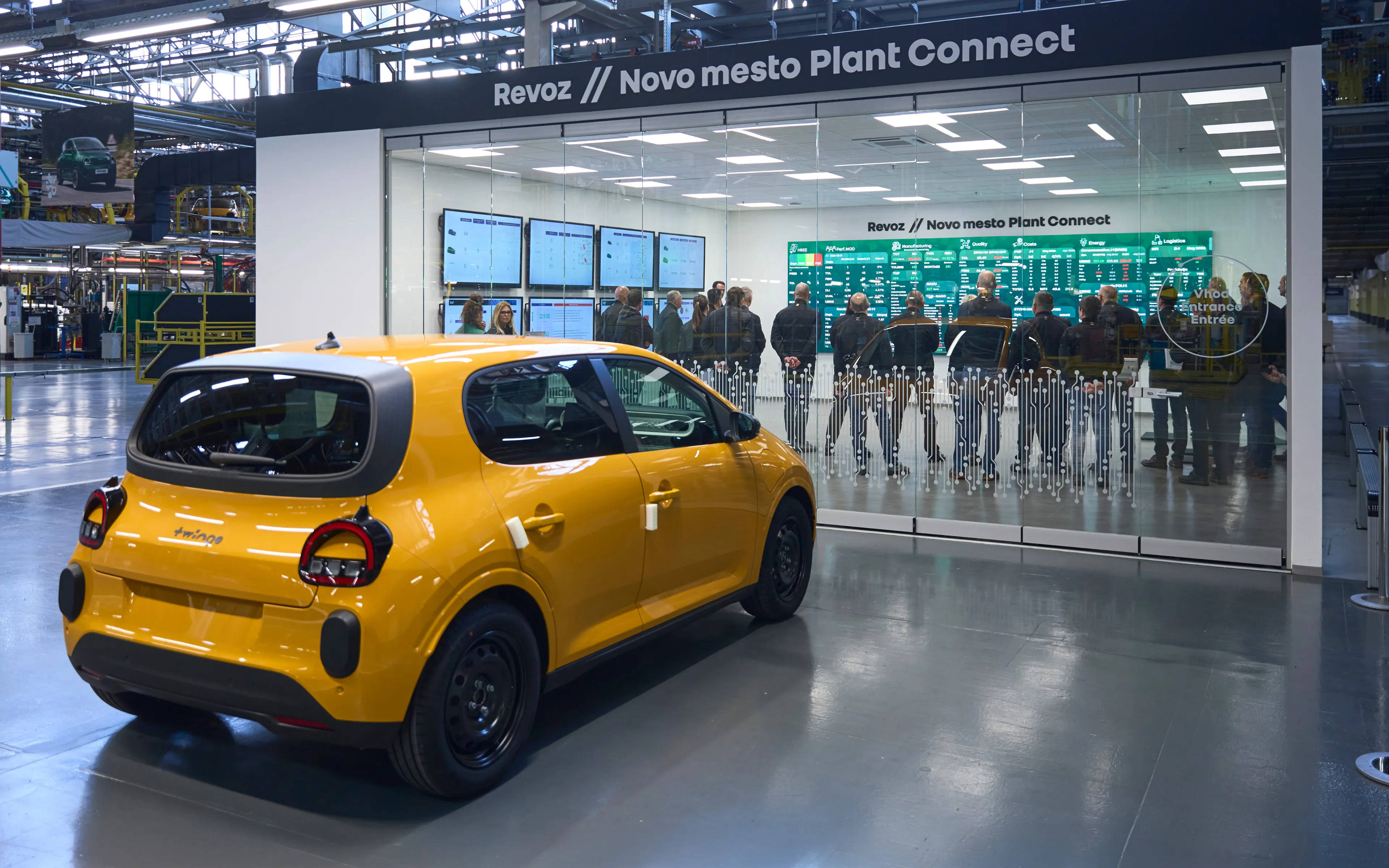
New Twingo, produced in Novo Mesto, perfectly illustrates this approach: quality designed in from the very beginning, notably through a significant reduction in the number of parts, validated through data and proven across millions of kilometres driven before customers even receive their vehicles. One conviction guides the teams: speed must never come at the expense of quality, but instead be the result of better control over design and industrialisation.


Data-powered factories
In the Group’s plants, quality now relies on a range of advanced digital tools.
A few examples include:
- Artificial Intelligence (AI)-powered automated inspections: 10 AI-based controls per plant in 2021, 500 today, and 1,000 by 2027. These systems can detect defects invisible to the human eye (bodywork gaps measured to a tenth of a millimeter, micro paint defects, insufficiently latched connectors…). AI identifies anything that appears non-compliant without variability. Operators become supervisors and can focus on higher value-added tasks.
- The industrial metaverse: a real-time environment centralizing data from sites worldwide, enabling unprecedented precision in quality management.
- Parts traceability: each critical part can be individually tracked, from its production to its integration into the vehicle.
This exhaustive and standardized data structuring provides an instant view of compliance and performance, making decision-making and continuous improvement easier.


A major innovation is that factories are no longer only responsible for producing vehicles at the right quality level. They are now also involved in monitoring their vehicles after delivery.
With VIN Connect, every event can be traced back to the assembly line, step by step. Within minutes, teams can identify what happened, where, how, and which component needs action. To date, the plant can track 100 parts and 500 operations per vehicle (soon 300 parts and 1,000 operations).
In the plants’ Control Towers, all data from the network, diagnostics and telemetry converge. A roadside breakdown can now be detected in less than 30 minutes thanks to partnerships with towing and assistance companies. Previously, obtaining the same information could take nearly a month. Tomorrow, the target set under the futuREady plan is to reduce that timeframe to just 30 seconds.
This real-time, industrialized and shared visibility is fundamentally transforming how quality is managed.


A daily global review to stay one step ahead
At 6 p.m. every evening, the quality, engineering and manufacturing teams meet with Thierry Charvet for a global review of incidents reported worldwide. Thirty minutes of analysis, prioritization and adjustment of action plans. This model, inspired by industry management, is now applied to quality at the Group level.
This meeting, combined with real-time data from the metaverse, places Renault Group in a state of continuous improvement. Every incident is identified and addressed before it can become a recurring issue.
This organization directly contributes to the excellent results achieved this year (vs. 2021):
- 50% fewer incidents during the first year of use,
- 50% fewer breakdown-related tows,
- a quality ranking at the highest level in the sector.
These results are the outcome of everyone’s commitment: engineering, plants, supply chain, quality teams and commercial networks now operate as a single ecosystem, fully aligned around customer satisfaction.

“What makes the difference today is our ability to immediately link a field event to its root cause. This reactivity turns every potential incident into an opportunity for improvement.”
Antoine Sillard
Director of Industrial Quality and Incidentology, Renault Group
Delivering on the promise over time
Renault Group has profoundly modernized its approach to quality. The change is visible everywhere: in the way vehicles are designed, tested, manufactured, diagnosed and decision-managed.
Today, this momentum enables:
- controlled launches, with no spike in incident rates;
- a massive reduction in incidents, supported by real-time detection and analysis models;
- a promise kept over time, with vehicles whose reliability and durability steadily improve. With one guiding principle: ‘After five years, my car should be like new.’
A solid transformation, embedded in the company’s culture and fully aligned with Renault Group’s futuREady ambition: delivering ever more technological, reliable and long-lasting vehicles to every customer.
FAQ
01
How does Renault Group ensure a high level of quality from the launch of a model?
02
What is VIN Connect and how does this tool improve quality?
03
What are the main results of the quality plan launched at the end of 2021?
04
How does New Twingo illustrate Renault Group’s new approach to quality?
Through a combination of many factors: robust design, real-life testing via quality runs, advanced factory digitalization, AI-powered automated inspections and a daily global review that allows action plans to be adjusted in real time.
VIN Connect makes it possible to trace the complete history of each vehicle, step by step, from production onward. In the event of an incident, teams can immediately identify where to intervene, speeding up resolution and strengthening process robustness.
The Group reports a 50% reduction in incidents during the first year of use and a 50% drop in breakdown-related towing. Recent launches rank among the best in the industry in terms of both reliability and durability.
New Twingo, produced in Novo Mesto, embodies the way Renault Group now develops its vehicles: with quality integrated from the earliest stages of development, validated through data and proven in real-life conditions even before market launch. Despite faster development cycles, the level of quality standards remains unchanged, with one clear objective: moving faster without ever compromising vehicle reliability and durability.