Tangier factory, the industrial and logistics hub where everything comes together
Published on
Article summary

Just a few kilometers separate Tangier’s plant, its suppliers, and the port: northern Morocco is home to one of the world’s most integrated automotive ecosystems, making Morocco an essential link in Renault Group’s global performance and a ‘textbook case’ in logistics.
Renault Group in Morocco: nearly a century of shared history
Present in Morocco for nearly a hundred years, Renault Group plays a central role in developing the country's automotive industry through its industrial, commercial, engineering, digital, and financing activities. Over the decades, the Kingdom of Morocco has become central to the Group's international industrial operations: it is today the Group's second global platform by volume, with over 394,000 vehicles produced in 2025, representing nearly one in six vehicles sold worldwide.
It is in Tangier and Casablanca (Somaca) that Renault and Dacia vehicles destined for local and international markets are produced.


This commitment is no accident: it is based on a long-term strategic partnership with the Kingdom of Morocco as well as the collective mobilization of public and private stakeholders. Since 2016, successive agreements signed with the Moroccan state have enabled Renault Group to strengthen the country's automotive value chain and accelerate its industrial ambitions by structuring a dense network of suppliers and local capabilities.
« Over the years, Morocco has become a key pillar of Renault Group’s global industrial footprint, founded on industrial excellence, world-class logistics, skilled talent, and solid public-private partnership. This long-term collective commitment has enabled the emergence of a competitive automotive ecosystem with growing international reach, while supporting the industrial ambitions of the Kingdom. »

Renault Group Morocco: automotive industry leader and market leader
- Nearly a century of operations: 1st manufacturer established in the country
- 2nd largest industrial platform globally for Renault Group by volume, with 394,000 vehicles produced in 2025
- #1 on the Moroccan market, with 38% market share (Renault & Dacia)
- 8th largest global market by sales volume for Group brands
- Best-selling models in Morocco as of May 2026: 1. Dacia Logan, 2. Dacia Sandero, 3. Renault Clio, 4. Renault Express
- 82% of Tangier and Casablanca production exported to 63 destinations (notably France, Italy, Spain, Germany, Turkey…)
- Nearly 10,000 employees
Beyond its industrial contribution, Renault Group contributes to Morocco’s economic and social development, notably through IFMIA (Institute for Training in Automotive Industry Professions), which it has operated since 2011. This public institute has delivered 3.2 million hours of training in industrial skills (automation, robotics, electrification).
Beyond Renault, IFMIA supports the Moroccan automotive ecosystem by supporting suppliers, industrial partners, and youth employability initiatives in the Tangier region (30% of its activities), thereby strengthening the country’s industrial competitiveness in the long term.
Morocco: a particularly dynamic automotive market
Morocco is now establishing itself as one of Africa's most dynamic automotive markets. In 2025, with growth of +33%, it achieved a historic performance, driven by product renewal, returning demand, improved financing accessibility, and the arrival of new players.
Tangier: seamless logistics
A cornerstone of the globalized economy, logistics has become a first-order strategic lever, a role that recent crises, from the pandemic to disruptions in the Red Sea, have brutally highlighted.
To support its ambitions and establish itself as a key player in the automotive industry, Morocco has invested heavily in world-class industrial and logistics infrastructure. The result: around the Tanger Med port complex, production, suppliers, and logistics platform are concentrated within the same perimeter, optimizing costs, timelines, and performance. A dense network of 87 tier-1 suppliers, some of which are hosted in the complex's free trade zone, feeds the Tangier and Casablanca factories.
Tanger Med: combining an integrated model with strategic location
With 161 million tons handled in 2025 and over 11.1 million containers, Tanger Med is Africa’s and the Mediterranean’s leading port and the 17th largest globally.
Its strength lies in a dual advantage: an integrated logistics model that brings together port, industry, logistics, and services within activity zones hosting over 1,500 companies, and a geostrategic position on the Strait of Gibraltar.
Vehicle terminal
- Capacity of 1 million vehicles/year
- 20 hectares dedicated to import/export and transshipment of vehicles
- Direct connections with 24 countries, including Australia, South Africa, Romania, Slovenia, and Turkey
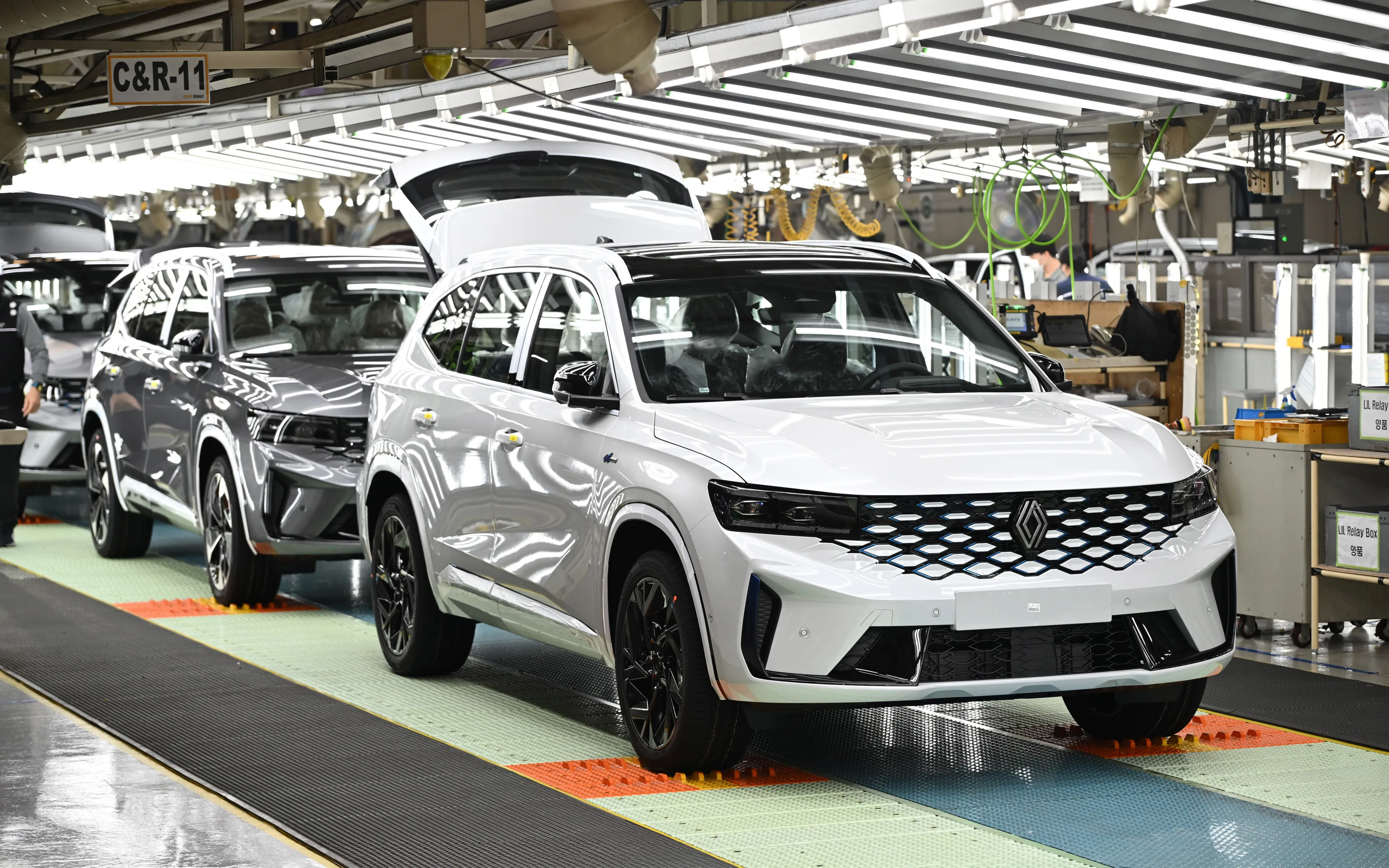
Located at the far north of the country, our Tangier factory, with 6,000 employees, is Africa's largest automotive factory and one of Renault Group's most competitive sites. One of its strengths lies in its immediate proximity to Tanger Med.
For flow control now requires port infrastructure, which has become strategic for securing deliveries. Backed by Africa's and the Mediterranean's leading port, the factory benefits from a maritime, rail, and road network that ensures rare logistics fluidity. Two railway lines penetrate the heart of the site itself: multiple daily rotations transport vehicles, fresh off the assembly line, to the port. Beyond performance, rail addresses a dual challenge: it addresses driver shortages through optimized capacity management, particularly over long distances, while reducing the carbon footprint by approximately 90% compared to road transport.


This direct integration of the factory, free trade zone, and port enables joint cost and timeline control. A configuration that makes Tangier a premier logistics platform and a true strategic lever for the Group.

« Within a radius of just a few kilometers, Morocco brings together the Tangier factory, the suppliers’ free trade zone, and Tanger Med port, creating a model of efficiency unique in the automotive industry. This exceptional proximity between production, suppliers, and logistics makes northern Morocco one of the world’s most integrated automotive ecosystems. »
Tangier Factory's Environmental Performance
The Tangier factory is among Renault Group’s most advanced industrial sites in terms of environmental performance. It relies in particular on a biomass boiler and wind energy, which covers nearly 90% of its energy needs, thus significantly reducing reliance on fossil fuels. Combined with a closed-loop industrial water recycling system, this approach illustrates the Group’s commitment to reconciling industrial performance with resource preservation.
Real-time visibility, powered by Artificial Intelligence
In Morocco, as in all the Group's logistics platforms, Supply Chain teams operate a fully integrated logistics ecosystem, covering all global flows of parts, components, and vehicles. Every day, this network mobilizes thousands of road, rail, and maritime transports to feed our factories.
To orchestrate this large-scale operation, Supply Chain relies on three complementary 'Control Towers':
- The Inbound Control Tower tracks supplies to factories and anticipates supply disruption risks;
- the Outbound Control Tower guarantees the timeliness of vehicle shipments, monitoring land, rail, and maritime flows to the commercial network;
- the Business Continuity Plan Control Tower continuously monitors the global environment to detect events that could affect the Group (strikes, weather hazards, geopolitical crises, etc.) and trigger measures to maintain flows.
Optimized by artificial intelligence, these three control towers provide teams with real-time visibility across all flows, anticipate disruptions, and secure both supplies and deliveries.
Renault Group Morocco Supply Chain in numbers
Inbound flows
- 69,100 trucks/year
- 12,000 containers/year
Outbound flows
- 63 destinations
- 26,400 trucks/year
- 1,440 trains/year (240 vehicles per train)
- 290 ships/year
- 8,000 vehicles/week
- 1 dedicated quay for Renault Group at Tanger Med port
From local sourcing to export to 63 destinations, Morocco's platform illustrates strategic logistics at its best: Transforming favorable geography into sustainable performance. By combining proximity of infrastructure, flow integration, and operational excellence, Renault Group has made Morocco one of its industrial pillars and a model integrated automotive ecosystem. A solid foundation on which the Group will build its future ambitions in the country.