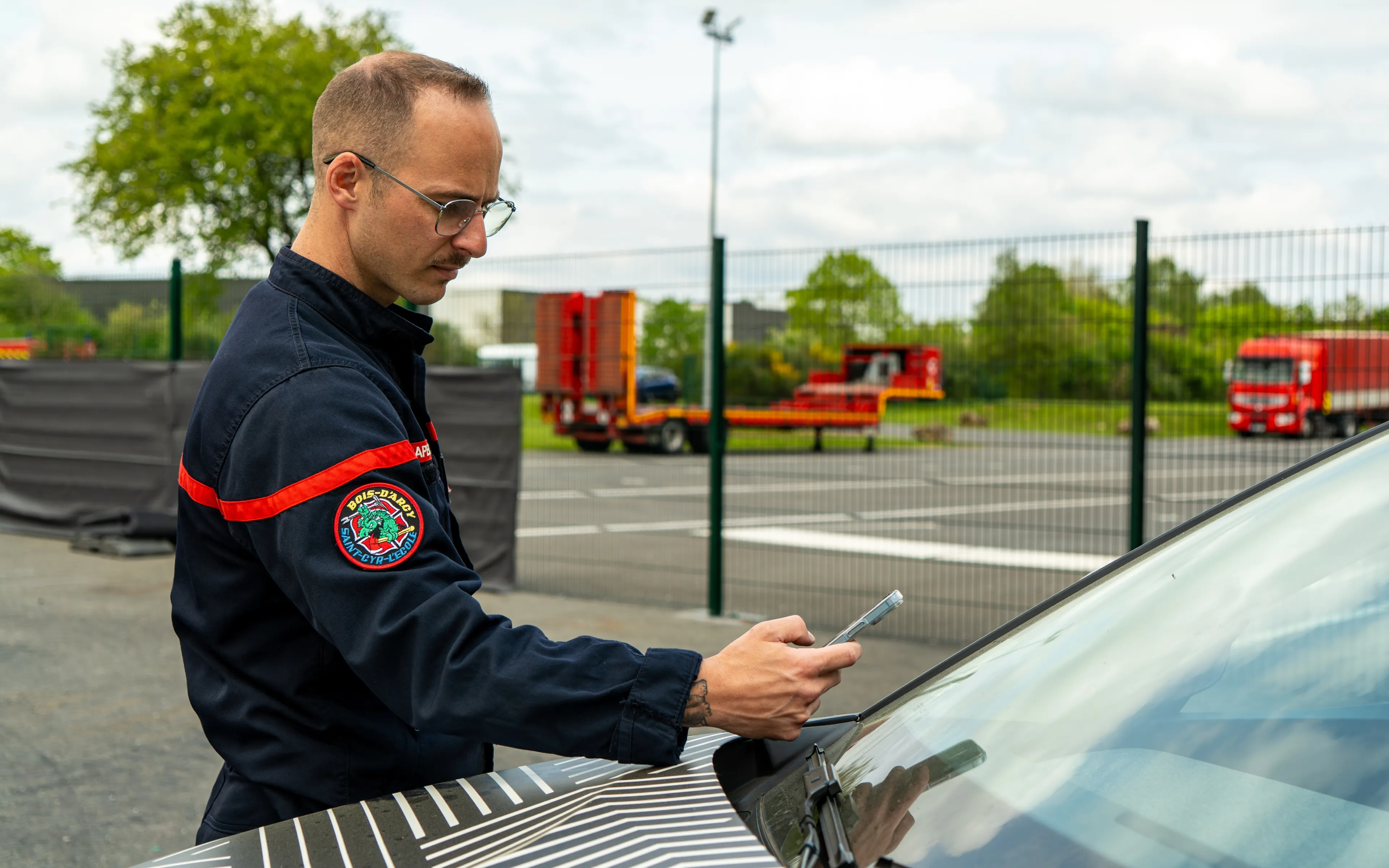
Ensuring the safety of road users is a shared commitment among all the teams involved in the development of our brands’ vehicles. At Renault Group, road safety is addressed across the entire spectrum of accidentology, from prevention to rescue, through the close collaboration we have maintained with fire and rescue services for the past sixteen years
Summary
In terms of prevention and road safety, Renault Group focuses on the human factor, which remains the primary cause of road accidents.
This approach is embodied in human first, a 360° safety program based on risk anticipation and detection, and on encouraging safer driving behaviors.
Renault Group works alongside fire and rescue services through a long-standing partnership aimed at facilitating emergency response and advancing road safety standards
Placing the human factor at the heart of our road safety prevention strategy
When it comes to road safety, the automotive industry initially focused on manufacturing vehicles that were as robust as possible, with reinforced structures to protect the passenger compartment and its occupants and equipped with essential active and passive safety systems (seatbelts, airbags, emergency braking assistance, anti-lock braking systems, etc.). This strategy has helped dramatically reduce the number of road accidents since the 1980s.
However, around 20,000 fatal accidents are still recorded every year in Europe. The main cause? The human factor — inappropriate speed, alcohol consumption, fatigue, loss of reflexes, risky behavior — which is involved in 90% of cases.
“Based on this observation, we decided to put the driver back at the heart of our accident prevention approach,” explains Stéphane Buffat, Road Safety Expert Leader and Head of the Accidentology, Biomechanics and Driver Behavior Research Laboratory (Le LAB*) at Renault Group.
This approach has a name: human first. A 360° automotive safety program that addresses the entire spectrum of accidentology, depending on whether the accident risk is potential, imminent or actual.
It is built around several key pillars:
Leveraging data from both the car and the driver to analyze and target the causes of accidents
Using technology to continuously enhance vehicle safety systems
Collaborating to innovate and benefit from the expertise of our partners
The goal? By 2030, to have human first technologies cover 70%** of accident causes.
*The LAB is a laboratory specializing in accident research, biomechanics, and human behavior studies, founded in 1969 by the Renault Group and Stellantis **fatal accidents or accidents resulting in injuries requiring hospitalization involving a passenger car or a light commercial vehicle
Anne Vermonet, VP Engineering Cross Car Line, and Stéphane Buffat presented the human first program at the 2026 edition of the ChangeNOW Summit for planetary solutions, held on March 31, 2026 in Paris.
Anne Vermonet, VP Engineering Cross Car Line, and Stéphane Buffat presented the human first program at the 2026 edition of the ChangeNOW Summit for planetary solutions, held on March 31, 2026 in Paris.
Anne Vermonet, VP Engineering Cross Car Line, and Stéphane Buffat presented the human first program at the 2026 edition of the ChangeNOW Summit for planetary solutions, held on March 31, 2026 in Paris.
Enhancing our active safety systems through technology
One of the core pillars of the human first program lies in the continuous enhancement and improvement of active safety systems (driver assistance technologies, or ADAS) designed to help prevent accidents. Thanks to technological advances, the ADAS embedded in Renault Group vehicles can address an increasing number of risky situations, such as alerts when crossing the center line or when an insufficient safety distance is detected. More recently, this also includes lateral obstacle detection when opening a door, a feature available on many Group vehicles, including Duster in India.
These systems are no longer limited to Europe but have been rolled out across all markets where the Group’s vehicles are sold. This is the case for Renault Boréal, marketed in 70 countries and equipped with 24 ADAS, as well as Renault Filante, recently launched in Korea, which features around thirty driver assistance systems.
Targeting risky driving behaviors
“As technological advances enabled us to make our vehicles safer, our focus gradually shifted toward anticipating potential accidents by seeking to prevent risky driver behaviors, through a guidance and coaching approach supported by dedicated tools,” Stéphane Buffat continues.
These solutions include:
Safety Coach, which analyzes driving behavior in real time and provides personalized advice.
Safety Score, which assigns a score from 0 to 100 to encourage safer driving.
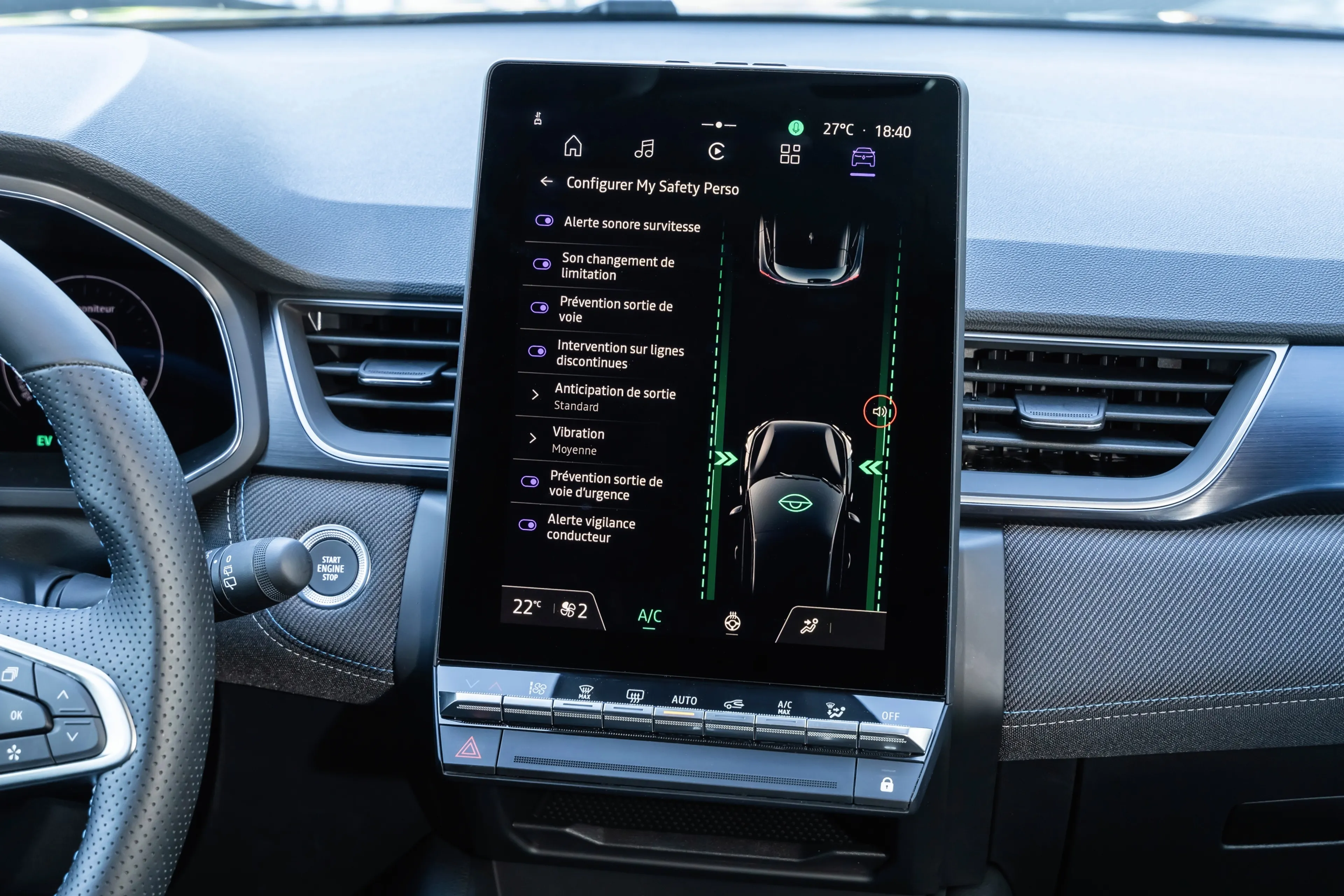
My Safety Switch, which allows drivers to activate their preferred ADAS settings with a single action — a particularly valuable feature given the GSR2 requirement for automatic activation of safety systems.
“Our goal is to make our technology accessible to as many people as possible. That is why Safety Coach is available across all Renault passenger cars in Europe at no extra cost since we launched Scenic E-Tech electric,” explains Anne Vermonet, VP Engineering Cross Car Line at Renault Group.
The Group’s commitment does not stop when an accident unfortunately occurs. This is the very purpose of a truly unique collaboration: the partnership established in 2010 between Renault Group and fire and rescue services.
Collaborating and innovating with emergency services
“With this collaboration, we have adapted our approach to innovation by focusing on real-world needs on the support we can provide to emergency responders, and on the concrete improvements and adaptations they need to intervene as quickly as possible and save precious minutes”
Among the innovations developed in close cooperation with emergency services is Fireman Access, now integrated across all the Group’s electric vehicles, with its patents opened to competitors one year ago.
“In the event of a battery fire, this system significantly reduces the time required to extinguish the fire by providing direct access to the heart of the battery. We act six times faster and use ten times less water. It is the only system that allows us to project water directly into the battery — and it has been doing so for sixteen years”, explains Nicolas Granier, Lieutenant Colonel with the Yvelines Departmental Fire and Rescue Service.
Cléa Martinet and Nicolas Granier presented the principles and tangible outcomes of the partnership between Renault Group and fire and rescue services during a keynote at the ChangeNOW Summit in Paris on March 31, 2026
Nicolas Granier presented Fireman Access at a press event dedicated to innovation in sustainable development and road safety on June 8, 2026
The collaboration has also led to the development of a valuable tool for emergency response: QRescue, a QR code placed at both the front and rear of the vehicle, providing direct access to the vehicle’s rescue sheet with essential information (location of batteries, high-voltage cables, structural reinforcements, etc.).
Renault Group has just unveiled the latest innovation resulting from this unique partnership: the Rescue Seat. This new device enables firefighters to unlock the backrest of the front seats using their power screwdrivers during a rescue operation. The seat can then be laid flat, making it easier to extract casualties from the rear of the vehicle.
Demonstration of the Rescue Seat at a press event dedicated to innovation and road safety on June 8, 2026.
Demonstration of the Rescue Seat at a press event dedicated to innovation and road safety on June 8, 2026.
Demonstration of the Rescue Seat at a press event dedicated to innovation and road safety on June 8, 2026.
All these tools have been designed in close cooperation with emergency services, tested in real-life situations and continuously enhanced thanks to their operational feedback.
The partnership between Renault Group and fire and rescue services is indeed part of an ongoing process of training and knowledge sharing. Awareness sessions, joint exercises and real-world testing in France and internationally help anticipate emergency situations and adapt solutions to field constraints.
This trust-based relationship, built over time, contributes to advancing road safety standards for the benefit of all.
FAQ
01
What does road safety mean for Renault Group?
02
What is the human first program?
03
How does Renault Group address risky driving behaviors?
04
What does the partnership between Renault Group and fire and rescue services involve?
For Renault Group, road safety means taking action across every stage of accidentology, from risk anticipation to emergency response when an accident occurs. It aims to protect all road users – drivers, passengers, pedestrians, cyclists and motorcyclists – by combining the human factor, safety technologies and cooperation with on-the-ground stakeholders. Road safety is a core pillar of the Group’s sustainability strategy.
human first is Renault Group’s 360° automotive safety program. It places the driver at the heart of accident prevention, relying on accident data analysis, the development of safety technologies, and collaboration with expert partners. The objective is that, by 2030, human first technologies will cover 70% of the causes of fatal accidents or accidents resulting in hospitalized injuries involving passenger cars or light commercial vehicles.
Renault Group develops driving advice and coaching tools designed to raise awareness and support drivers in their daily journeys. Solutions such as Safety Coach, Safety Score and My Safety Switch analyze driving behavior, encourage safe practices and facilitate the use of driver assistance systems, through an educational and non-intrusive approach.
Since 2010, Renault Group has been working closely with fire and rescue services to facilitate and speed up emergency response in the event of an accident, particularly involving electrified vehicles. This partnership has led to the development of Fireman Access, access to rescue sheets via QR codes, as well as ongoing training and knowledge-sharing initiatives. A long-term collaboration — notably illustrated by the full-time secondment of a firefighter alongside Renault Group teams — which contributes to advancing road safety standards.